

Criminal legal fines and fees include traffic and parking tickets and court- or incarceration-related costs. Fines are intended to penalize people for violating the law and deter future violations, and fees are designed to pay for public services. However, state and local governments seldom impose fines or fees with regard to people’s ability to pay.
This factsheet uses December 2024 data from the Urban Institute’s Well-Being and Basic Needs Survey (WBNS) to examine how common it is for people to be asked about their ability to pay fines and fees and to be offered any affordability options. Unlike most prior research examining ability-to-pay and affordability practices, the WBNS is a nationally representative survey of adults and hence illustrates national prevalence. Our findings can equip changemakers with the evidence needed to ensure that criminal legal systems are administered fairly and efficiently.
Fewer than one in four states require judges to conduct an ability-to-pay determination when imposing fines or fees; in fact, judicial practices can be inconsistent within the same state. Prior Urban Institute research found that 6 percent of nonelderly adults reported their households owed money for unpaid fines and fees incurred in 2023 or prior years. Among those who owed money, one in four owed over $1,000. Those unable to pay court- or incarceration-related fines and fees, in particular, often faced severe consequences, such as having their driver’s licenses suspended. Such sanctions can have counterproductive impacts because they can hinder working people from getting to their jobs so they may earn enough to pay their fines and fees.
If state and local governments were to eliminate various fines and fees and their respective debts, the resulting economic relief would support many residents experiencing food insecurity and other hardships. However, leaders may be reluctant to eliminate them due to public safety and fiscal concerns: fines may deter future violations like dangerous driving, and fees can be a key source of revenue. We know that imposing standard amounts will have differing impacts based on people’s incomes or savings. Therefore, as an intermediate step, state and local governments could routinely consider people’s means to afford fines and fees.
Most people charged fines or fees were not asked whether they could afford to pay
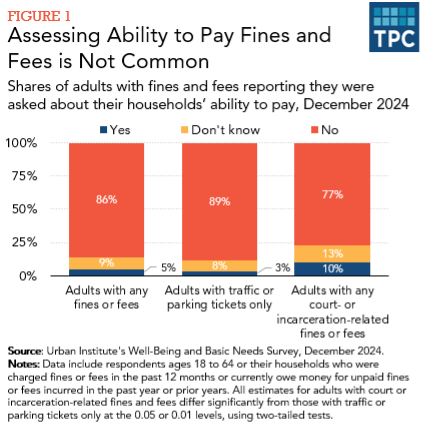
Among adults whose households were charged a fine or fee in 2024 or owed money from charges in 2024 or prior years, only 5 percent reported that court or government staff asked whether they could afford to pay them (figure 1). In other words, fines and fees are largely being assessed without taking into account people’s incomes or savings. Ten percent of those facing any court- or incarceration-related costs were asked about their ability to pay, compared with just 3 percent of those with only parking or traffic tickets (figure 1). This may reflect differences in amounts charged or procedural differences when people are present in court and have attorneys present.
The US Department of Justice has issued guidance to all state and local courts on how ability to pay assessments would better serve jurisdictions’ interests while making governance more efficient. In Rhode Island, for example, judges must ask at sentencing about a person’s ability to pay and waive costs if a defendant is determined “indigent” based on receipt of means-tested public benefits or other criteria. Rhode Island state court staff also hold community-based events where people may request a waiver or reduction outside of the courtroom.
Payment plans were more common than fine or fee reductions, waivers, or community service
Regardless of whether courts and government agencies explicitly ask about an individual’s ability to pay, they may offer certain alleviation measures or payment alternatives. Practices vary widely on when they offer relief (e.g., either at sentencing or post-conviction), how they offer it (either routinized or by request), and how much relief they provide.
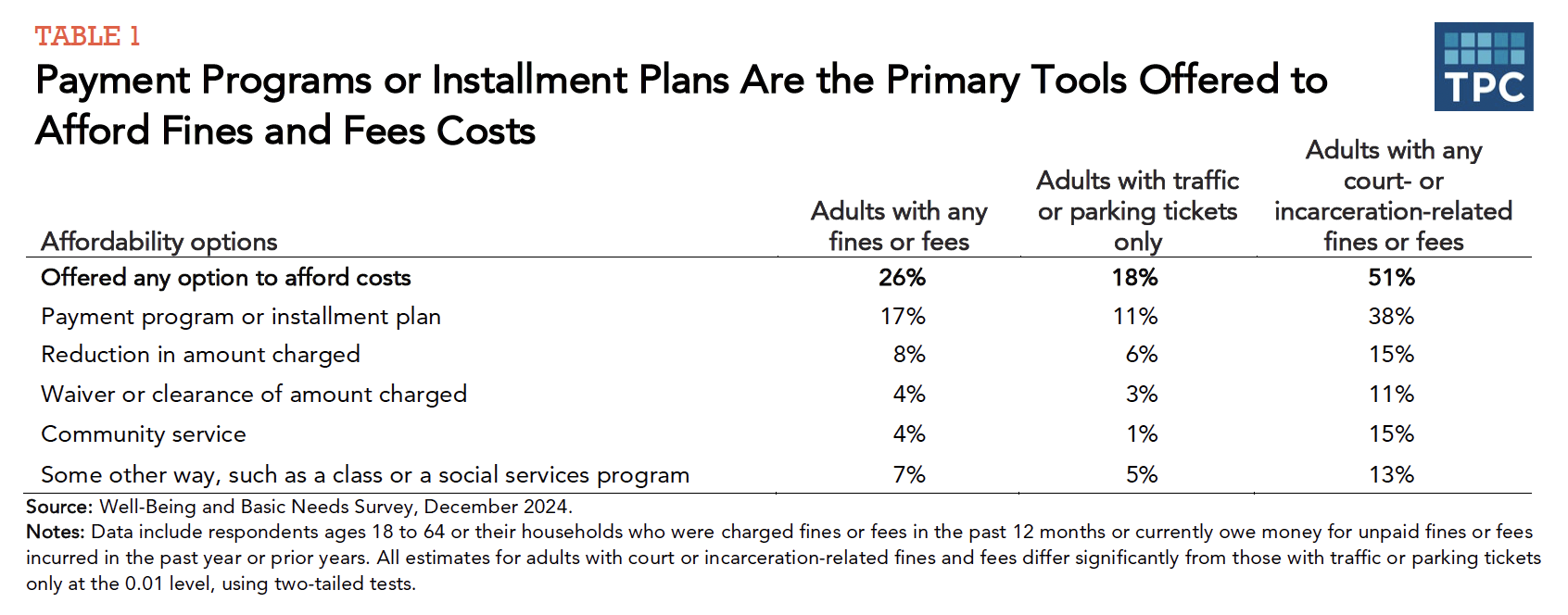
Among adults whose households were charged a fine or fee in 2024 or owed money from charges in 2024 or prior years, one in four (26 percent) reported they were offered some way of affording their fines or fees (table 1). Adults with court- or incarceration-related costs were more likely to report any affordability option (51 percent) than those with parking or traffic tickets only (18 percent). Payment plans or installment plans were more common than other options offered to afford fine or fee costs, such as reductions, waivers, community service, or social services programs (table 1).
Several jurisdictions are exploring alternatives to lessen fine or fee burdens. California’s MyCitations tool allows individuals, based on their economic circumstances, to easily file a request online for a judge to reduce their citation without having to appear in court. New Mexico recently expanded community service options and increased the “hourly rate” of credit received towards discharging fines and fees. Similar approaches may help mitigate the negative impacts of fines and fees on individuals who may not have the means to afford them.