

At the beginning of each year, millions of Americans prepare and file their income tax returns. They determine how much they owe and how much they already paid via withholding or estimated tax payments. If they owe less than they paid, they get a refund. Most taxpayers received a refund when they filed their 2024 tax returns, with the average refund being over $3,000.
In recent decades, the tax system has become the primary source of cash benefits for working families with low incomes and children through tax credits like the earned income tax credit (EITC) and the refundable portion of the child tax credit (CTC), which can increase families’ incomes by thousands of dollars. Because filing a tax return effectively functions as an application for these benefits, tax filing is essential to ensuring that eligible families receive their tax credits. Indeed, when families file, nearly all receive the income-boosting tax credits they are eligible for.
But filing a tax return and navigating the tax code’s eligibility rules can be burdensome and complex, making it harder for taxpayers to understand and follow the rules on their own. These complexities may increase due to new provisions of the One Big Beautiful Bill Act.
Faced with these challenges, many people seek assistance in preparing and filing their returns, either from paid practitioners or from tax preparation software. These options may be costly for some and reduce the value of the tax benefits they receive. Further, some options may be associated with higher rates of improper claims, which can lead to increased scrutiny of tax benefits like the EITC and raise the likelihood that taxpayers who claim these benefits are audited, a process that can be costly and stressful. Understanding households’ tax-filing choices can inform efforts to help them save money on filing costs, maximize refunds they are eligible for, and file accurate tax returns.
This research uses December 2024 data from the Urban Institute’s Well-Being and Basic Needs Survey (WBNS), a nationally representative survey of adults ages 18 to 64, to examine people’s tax-filing methods and motivations for choosing these methods. Some prior research suggests that convenience and cost, as well as psychological factors like the perceived risk of getting audited, drive people’s choice of tax-filing methods. The IRS’s individual taxpayer burden surveys have explored the time and financial costs involved with tax compliance, though limited information has been made publicly available. The WBNS adds to our understanding of how people file their tax returns and why they choose their filing methods, which can help Congress and the IRS develop solutions that make tax filing more accessible, affordable, and accurate for all.
Most US residents are required to file an annual income tax return. According to the WBNS, 84 percent of nonelderly adults reported that their households filed a tax return in the 12 months prior to December 2024 (data not shown). Taxpayers have many filing options, including those that are paid or free and those that can be accessed in person or online; a small share prepare paper returns by hand and mail them in. Most taxpayers file through paid preparers, such as accountants or tax professionals, or online using commercial tax preparation software, such as TurboTax or H&R Block.
Those seeking free tax-filing options can go to Volunteer Income Tax Assistance (VITA) and Tax Counseling for the Elderly (TCE) sites or use free versions of online commercial tax preparation software. Eligibility for these free services varies depending on taxpayers’ income level, income sources, and claims for certain credits or deductions. Some free software options are offered through the IRS’s website as part of the IRS’s Free File program. Though many taxpayers are eligible for free services under this program, uptake is low. In other cases, software companies offer free options outside of the Free File program. A taxpayer may begin to prepare their tax return through commercial software assuming they will pay $0, as is commonly advertised, but end up paying for services. In 2024 and 2025, many taxpayers had the option of filing their federal tax returns electronically for free through the IRS’s Direct File pilot; however, that program was eliminated in 2025. Existing administrative data on how many taxpayers actually file for free using commercial software outside of the Free File program is unavailable absent Congressional action.
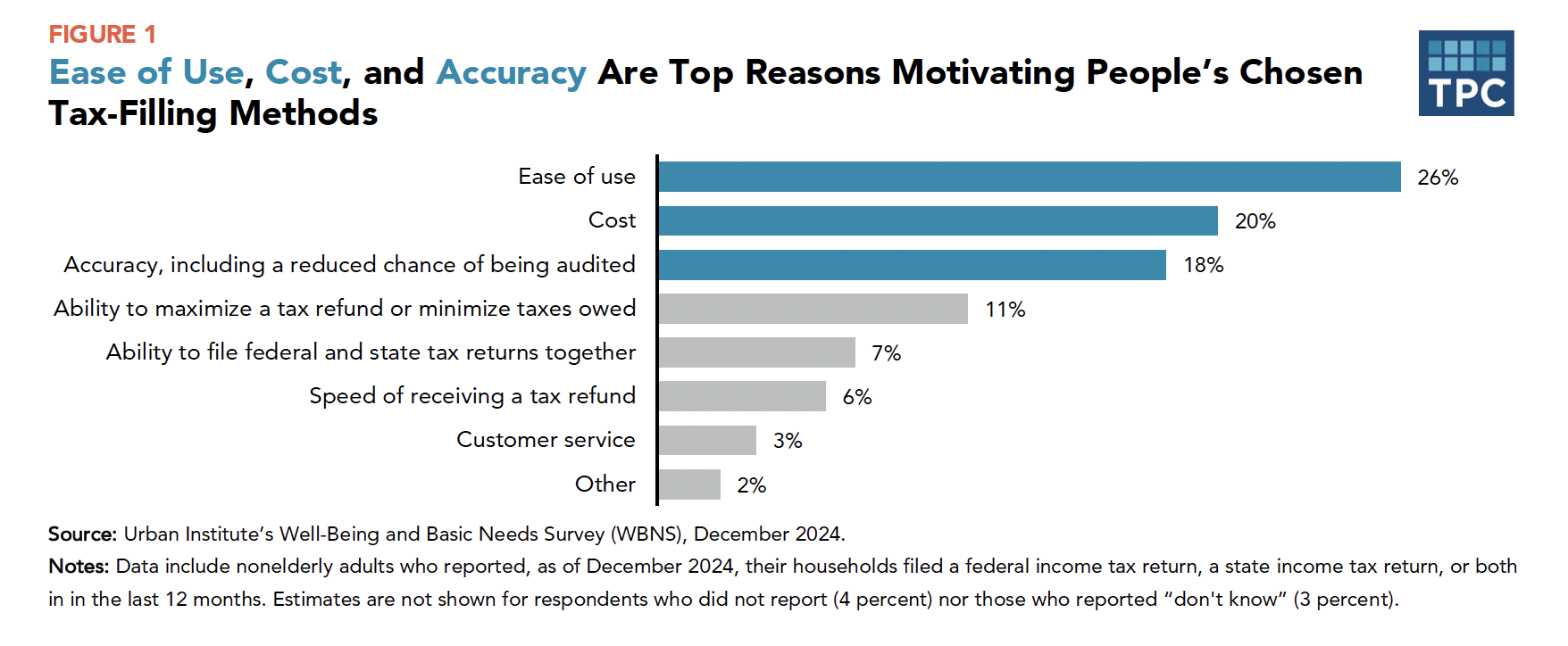
According to the WBNS, the top reasons motivating nonelderly taxpayers’ chosen tax-filing methods were ease of use (26 percent), cost (20 percent), and accuracy, including the belief that using a particular method reduced their chance of getting audited (18 percent; figure 1).
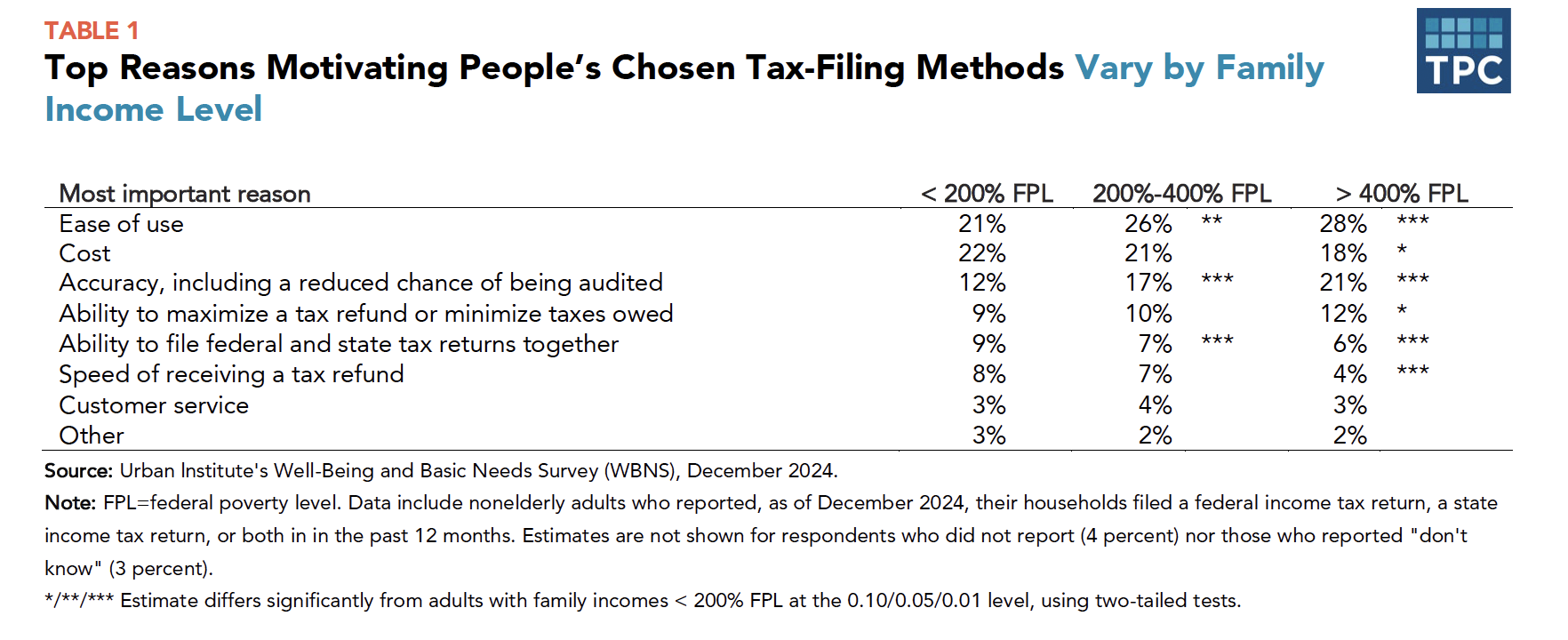
The relative importance of these reasons varied by family income (table 1). Those in families with low incomes (below 200 percent of the federal poverty level [FPL]) were significantly more likely than those in families with high incomes (at or above 400 percent of FPL) to report that cost, speed of receiving a tax refund, or the ability to file federal and state tax returns together were their most important reason behind choosing their tax-filing method. In contrast, those in families with high incomes were more likely to report ease of use, accuracy (including a reduced chance of getting audited), or the ability to maximize a tax refund or minimize taxes owed as their top reason. In part, these differences may reflect economic circumstances: those in families with low incomes may understandably wish to pay less for tax filing services, minimize hassle by filing federal and state tax returns together, and receive their refunds faster so they may be able to afford ongoing expenses or pay down their debts.
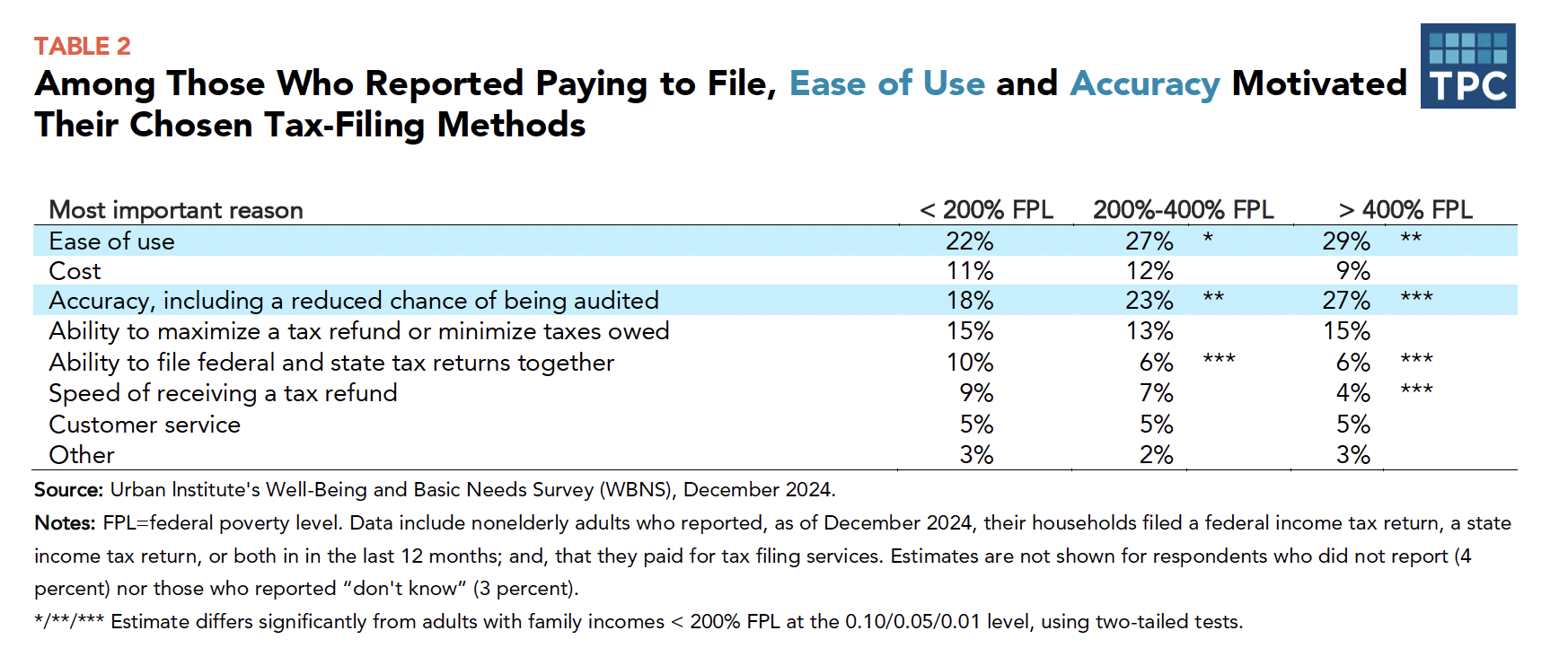
Among those who reported paying for tax filing services, ease of use, accuracy, and the ability to maximize refunds or minimize taxes owed outweighed cost as the most frequently reported top reason for their choice of filing method (table 2). Because families with low incomes are among the groups that could benefit most from free tax-filing services, understanding why they chose a paid service could inform better program design of free services. Like those with higher incomes, taxpayers with low family incomes who reported paying for filing services emphasized ease of use, accuracy, and maximizing refunds or minimizing taxes owed as their top reasons. They were also more likely than those with higher incomes to report that the ability to file federal and state tax returns together and the speed of receiving a tax refund were their most important reasons.
In choosing their tax-filing method, taxpayers are taking into consideration how convenient and easily navigable tax-filing methods are, which may include factors like whether they have a mobile-friendly interface, multilingual capacity, prepopulation of information from prior years and from forms like W-2s, and integrated state filing. Tax filers may also choose to pay for preparation and filing services because they perceive this cost to be “worth it” if it results in their tax refund arriving quicker or if they face fewer issues, like audits, down the road.
If Congress and the IRS want to improve tax compliance and make sure eligible households keep more of the benefits they have earned, these findings suggest policymakers should prioritize policies that ensure tax-filing methods are easy to use, provide taxpayers with information on their returns’ accuracy, and facilitate quick access to tax refunds, in addition to making filing methods affordable. Policymakers can accomplish these goals in a variety of ways, including reforms to the Free File program, renewal of the Direct File program, regulation of both noncredentialled paid preparers and online commercial tax preparation software, and expanded outreach and awareness efforts.
Most Americans, across varied demographic groups, had expressed interest in using the IRS’s Direct File program, and participants in the Direct File pilot rated their experience highly, but this pilot program has since been eliminated. Reductions to the IRS’s budget and taxpayer assistance services could also limit the availability and uptake of free and low-cost tax filing in subsequent tax-filing seasons, jeopardizing access to tax benefits among eligible populations.
Our findings also highlight the need for better data on how many people file their taxes for free. Prior investigations suggest that fewer people file for free using online commercial tax preparation software than anticipated. Some people may be unaware they are paying for a service if the costs are subtracted from their tax refunds.
As many Americans struggle to afford basic necessities, tax refunds will likely be important in helping many families make ends meet. Ensuring families can file their tax returns easily, affordably, and accurately increases the chances that eligible families receive refunds and benefits that strengthen their financial security.