

Prediction markets such as Polymarket and Kalshi have grown rapidly, with trading volume jumping from roughly $9 billion in 2024 to over $40 billion in 2025. So far, discussion of prediction markets has mostly focused on how they affect people’s wallets. But an important question remains: What do they mean for state budgets?
Prediction markets are emerging as a significant competitor to sports betting, which is now legal in 39 states and the District of Columbia. But sportsbooks operate within state regulations, and they generate tax revenues that feed into state budgets. By contrast, prediction markets operate outside those structures. As wagering migrates to these platforms, states could be on the losing end.
Gambling taxes can be appealing, but also carry risks for states
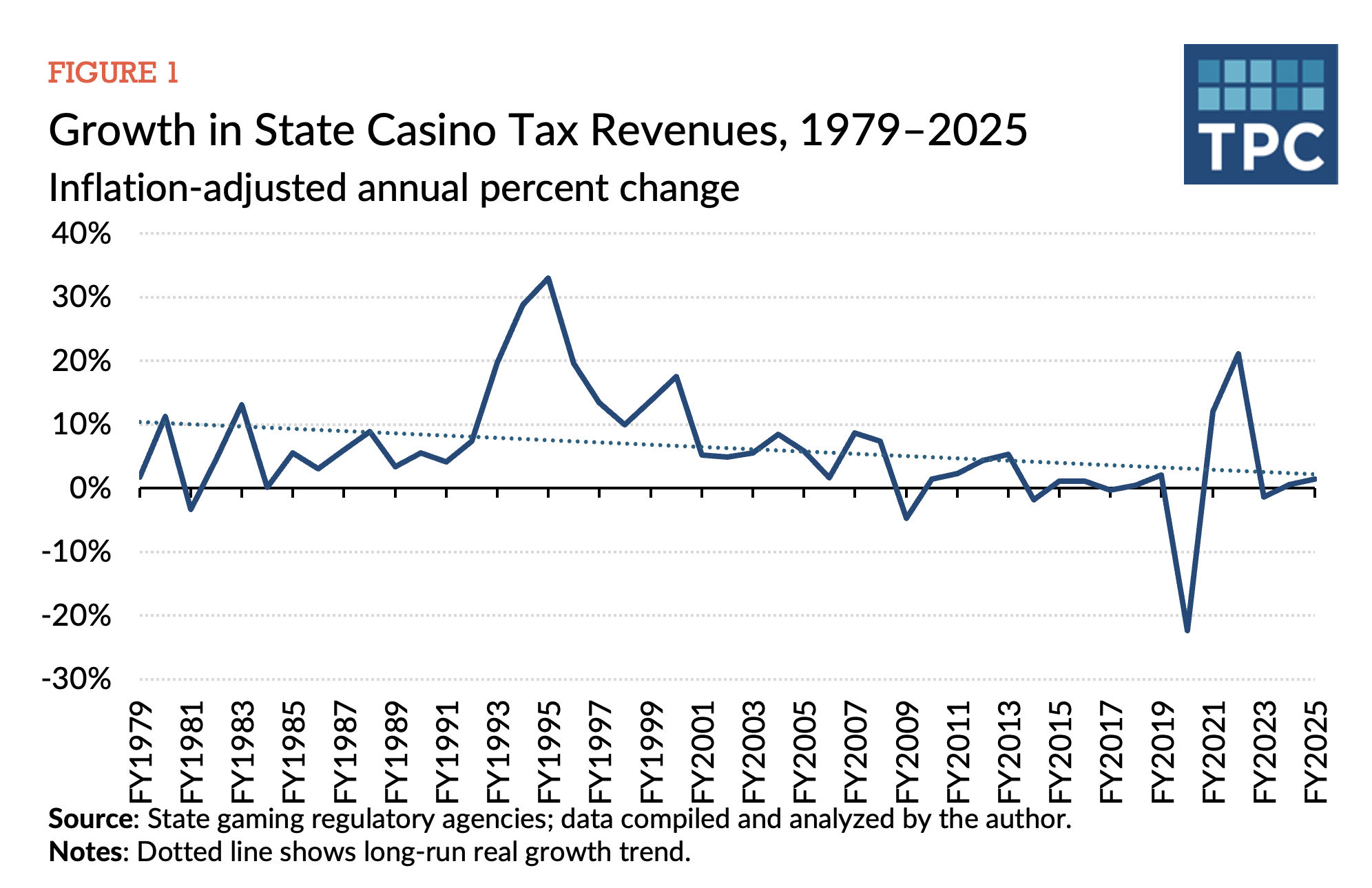
State governments have long turned to gambling expansion to generate revenue, often viewing it as more politically feasible than raising broad-based taxes. Casino legalization spread across the country beginning in the 1990s, but as casino markets matured and interstate competition intensified, growth in casino tax revenues slowed and became more volatile (Figure 1).
After the Supreme Court's 2018 decision opened the door for state legalization, sports betting emerged as a new source of gambling tax revenue. Importantly, those platforms are required to pay state taxes and purchase licenses, contributing directly to the state fisc.
Sports betting revenues are concentrated geographically, with New York accounting for roughly one-third of all state collections and New York and Illinois together generating nearly half. Those states could also be among the first to feel the losses as wagering shifts to prediction markets.
Even small shifts could matter
New York provides a good example of potential fiscal exposure. In state fiscal year 2026, the state's mobile sportsbooks generated approximately $2.6 billion in gross gambling revenue. With one of the highest tax rates in the nation (51 percent), that activity produced roughly $1.3 billion in tax collections dedicated to New York’s education, youth programs, and problem-gambling services.
Table 1 illustrates the potential fiscal exposure. Assuming that 1 percent, 5 percent, or 10 percent of sportsbook activity shifts to prediction markets, New York could forgo the following annual tax revenues.
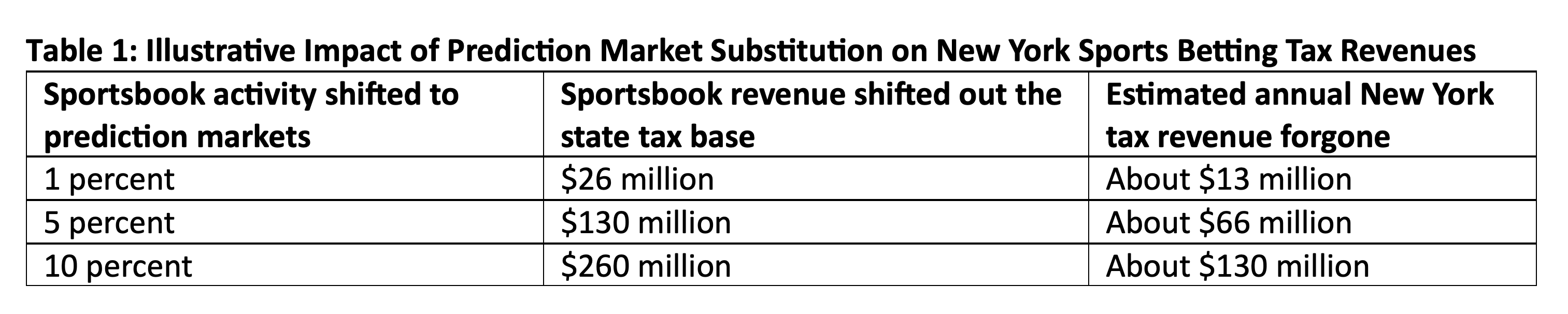
These losses matter not just because of their size but their effects on budget flexibility. As one state budget director put it, “The most important million is the last million in doing budgets.”
A large share (about 70 percent) of New York’s budget, like those of most states, is already committed to ongoing obligations such as education, Medicaid, pensions, and debt service, with little room for discretionary spending. Revenue erosion rarely triggers an immediate budget crisis, but it gradually reduces states’ available dollars to respond to economic downturns, replenish reserves, address emerging needs, or fund new policy priorities.
A new challenge for state tax policy
Several state lawmakers have already begun exploring options to incorporate these platforms into existing gambling tax frameworks or proposing new taxation approaches tailored to event-based trading.
According to the National Conference of State Legislatures, proposals introduced in 2026 range from licensing and regulatory requirements to measures that would explicitly tax prediction-market activity or treat certain contracts similarly to sports wagering. While the approaches vary, they reflect a growing recognition among state policymakers that the expansion of prediction markets raises not only regulatory questions, but also revenue questions. Whether these efforts succeed will depend on if they withstand likely legal challenges.
The broader lesson is familiar to state budgeters everywhere: Economic activity often moves faster than tax systems. Prediction markets are just the latest example.