
The IRS’s delayed 2025 update to its tax gap estimates will make it harder to assess how recent tax law and staffing changes affect compliance. The tax gap measures the difference between taxes legally owed and taxes paid voluntarily and on time. Policymakers use these estimates to assess the revenue-generating capacity of the tax system, identify sources of noncompliance, and guide tax policy and administration decisions.
For decades, the IRS has periodically estimated both the gross tax gap, taxes not paid voluntarily and on time, and the net tax gap, the portion unlikely ever to be collected. In recent years, demand from policymakers for more timely and relevant estimates prompted former IRS Commissioner Charles Rettig tocommit to expanding the estimates and supporting annual updates. The work produced new tax gap projections in 2023 and 2024.
The fall 2025 update, covering Tax Year 2023 and providing updates for earlier tax years, remains listed by the IRS as delayed. At recent hearings before the Senate Finance and the House Ways and Means Committees, IRS Chief Executive Officer Frank Bisignano questioned the utility of the tax gap estimates and stated that he was involved in a deep review of the data and methodology to determine how much of the gap was “addressable.”
Such a review may be warranted, but it should not delay scheduled updates, which will provide a crucial baseline for understanding the impact of recent tax-law and staffing changes. Any methodological changes also should follow federal information quality standards to preserve the quality, objectivity, utility, and integrity of this influential statistical data series.
IRS tax gap estimates reveal where compliance breaks down
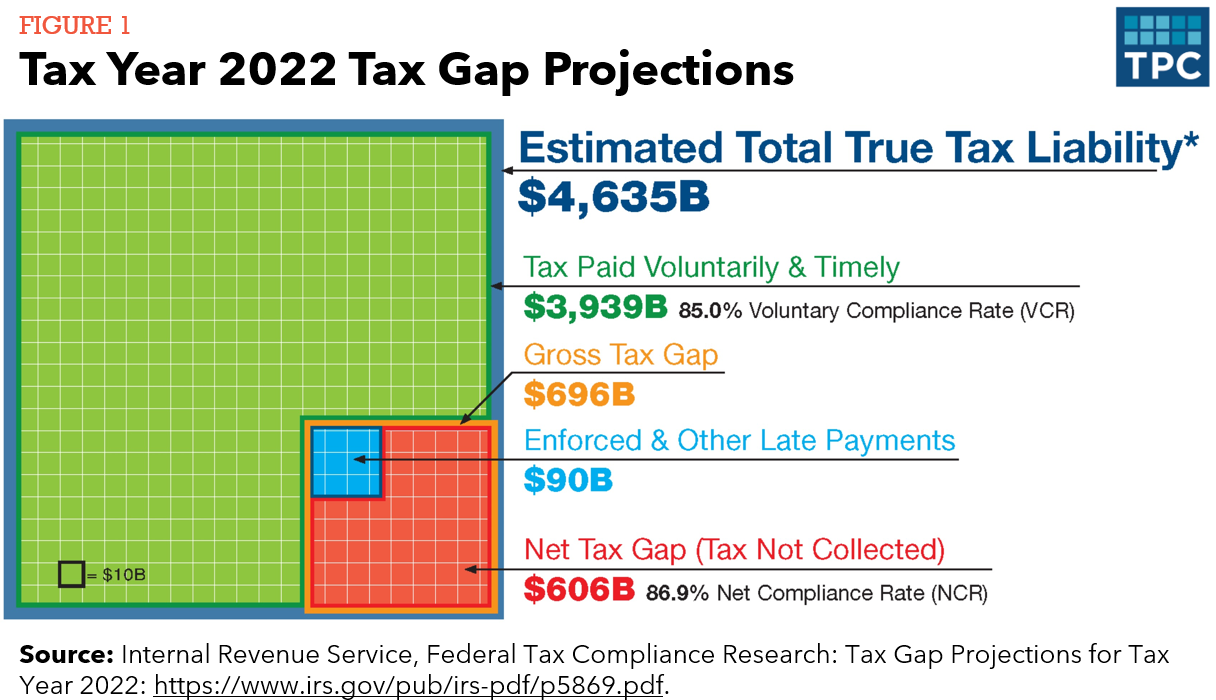
In October 2024, the IRS projected a $696 billion gross tax gap for Tax Year 2022. That means taxpayers paid 85 percent of total tax liability voluntarily and on time. These projections were very timely since tax returns for Tax Year 2022 were generally filed in calendar years 2023 and 2024. Figure 1 shows that about $90 billion of the unpaid total will eventually be collected, leaving a $606 billion net tax gap, about 13 percent of total true tax liability.
These projections draw on several sources, including a statistical sample of completed audits of individual tax returns for tax years 2014-2016. The IRS adjusted those older data to reflect 2022 filing patterns. As more recent audit data become available, the agency committed to update the projections and eventually publish final estimates. This approach resembles the process used for other economic statistics, including gross domestic product, in which preliminary estimates are refined as new data arrive.
Tax gap data guide policy and enforcement
Estimates of total true tax liability give policymakers a broad measure of how much revenue current law should generate. They can inform budget and tax policy decisions and show where noncompliance is concentrated (Figure 2).
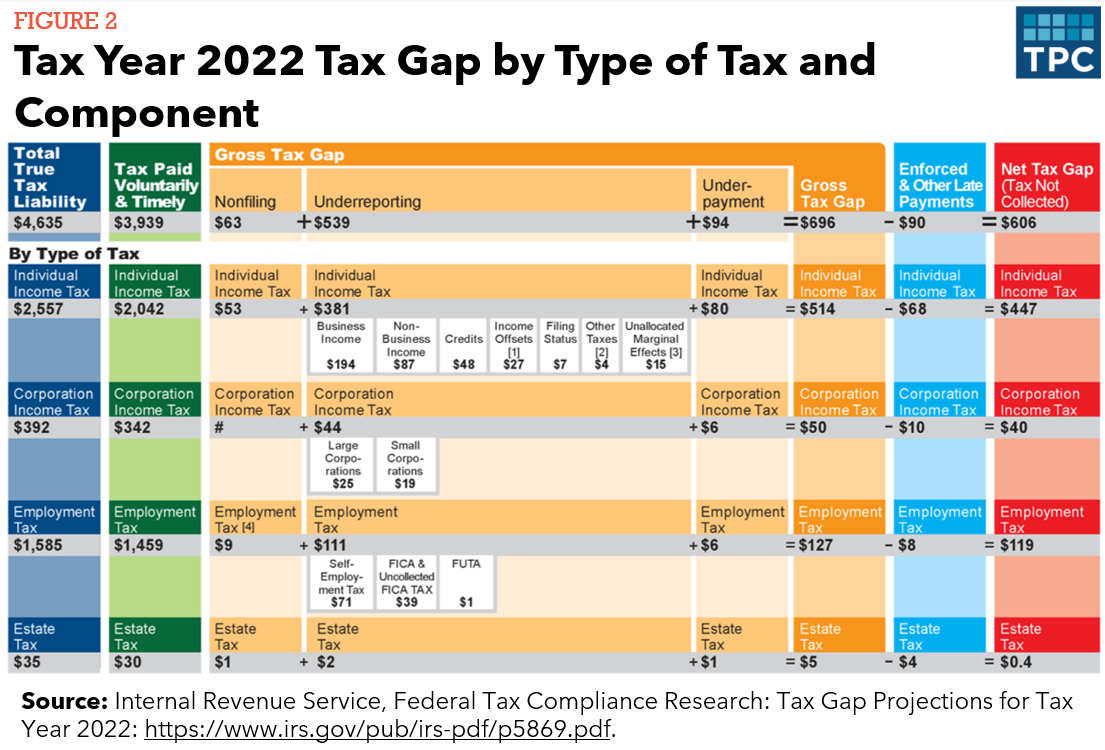
Breaking the 2022 gross tax gap into nonfiling ($63 billion), underreporting ($539 billion), and underpayment ($94 billion) helps distinguish different problems and possible responses (see Figure 2). The underpayment gap, which is tax reported on time but not paid on time, may point to collection tools such as installment agreements or liens. The nonfiling gap may call for targeted outreach to nudge income earners to file. The underreporting gap, tax understated on timely filed returns, may call for better third-party reporting, clearer rules, or targeted examinations.
Breaking the gap down by tax type also helps identify sources. The 2022 gross tax gap included $514 billion in individual taxes, $50 billion in corporate taxes, $127 billion in employment taxes, and $5 billion in estate taxes.
Individual income tax data show the strong relationship between information reporting and compliance. Taxpayers report wages and salaries, which are subject to tax withholding and Form W-2 reporting, with 99 percent accuracy. By contrast, the net misreporting rate is about 55 percent for income subject to little or no information reporting, including some sole proprietor, farm, rental and royalty income. This pattern can help policymakers weigh the costs and benefits of expanding third-party reporting in some sectors. The Government Accountability Office has used IRS data to identify several actions Congress and the agency could take to reduce the tax gap.
The estimates can be improved
The current reports provide useful, high-level information, but they have important limitations. In my 2021 testimony to Congress, I called for more timely identification of emerging compliance issues; better measurement of noncompliance that audits fail to detect; greater coverage of noncompliance involving foreign citizens and businesses; and more complete measures for complex partnerships.
The research program I instituted and is still in force at IRS uses advanced analytics including machine learning to yield more accurate methods for identifying underreported tax. That work could also help estimate the portion of the tax gap that the IRS can address without congressional action, as IRS CEO Bisignano has requested.
The IRS needs to publish updates on schedule
For decades, tax gap estimates have helped policymakers and tax administrators assess the federal tax system’s revenue capacity and the gap between taxes owed and taxes paid. Government watchdogs and outside researchers have repeatedly concurred with the estimation methodology, while offering suggestions that led to incremental improvements.
In April, IRS CEO Frank Bisignano told the Senate Finance Committee that the IRS was reviewing the “actual addressable tax gap and how to close that gap.” That emphasis suggests current leadership may be focused on using tax gap estimates to guide agency operations. That is a valid and important use, but methodological improvements must not disrupt planned annual updates of the existing measures that serve other important tax policy goals.
Instead, IRS leadership should ensure that staff have sufficient resources and professional independence to apply the best possible science to improve tax gap measures for all uses, while continuing scheduled releases. Without timely updates, policymakers and other users will have less evidence for judging how tax-law and staffing changes affect compliance and collections.