
Surging home values have amplified calls to cut or even abolish the property tax. Because property taxes rise with home values, homeowners may fear being squeezed by larger tax bills. Those fears aren’t unfounded: The median bill rose about 30 percent between 2019 and 2024—still far short of soaring home values, but with wide variation across states.
Yet despite sharp increases, property taxes have not run amok. The real challenge is finding practical ways to protect residents without undermining the fiscal bedrock of local governments.
What drives property taxes higher?
The property tax makes up about three-quarters of local government tax revenue, with significant variation across communities. Despite state limits, the property tax is often calculated as a residual: Local officials estimate public service costs, subtract other expected revenues, and then levy property tax rates to balance the budget. When inflation raises the costs of public services or when other revenues like sales taxes or transfers fall short, localities lean more heavily on property taxes. In states where this process does not apply, it is usually because of strict legal limits on how much the tax base or revenues can grow.
Assessments also matter. Assessed property values often lag behind market prices. Residential property makes up most of the tax base, but communities also rely on property taxes from commercial, industrial, and agricultural properties. If home values rise faster than other property values, the residential share of the base increases.
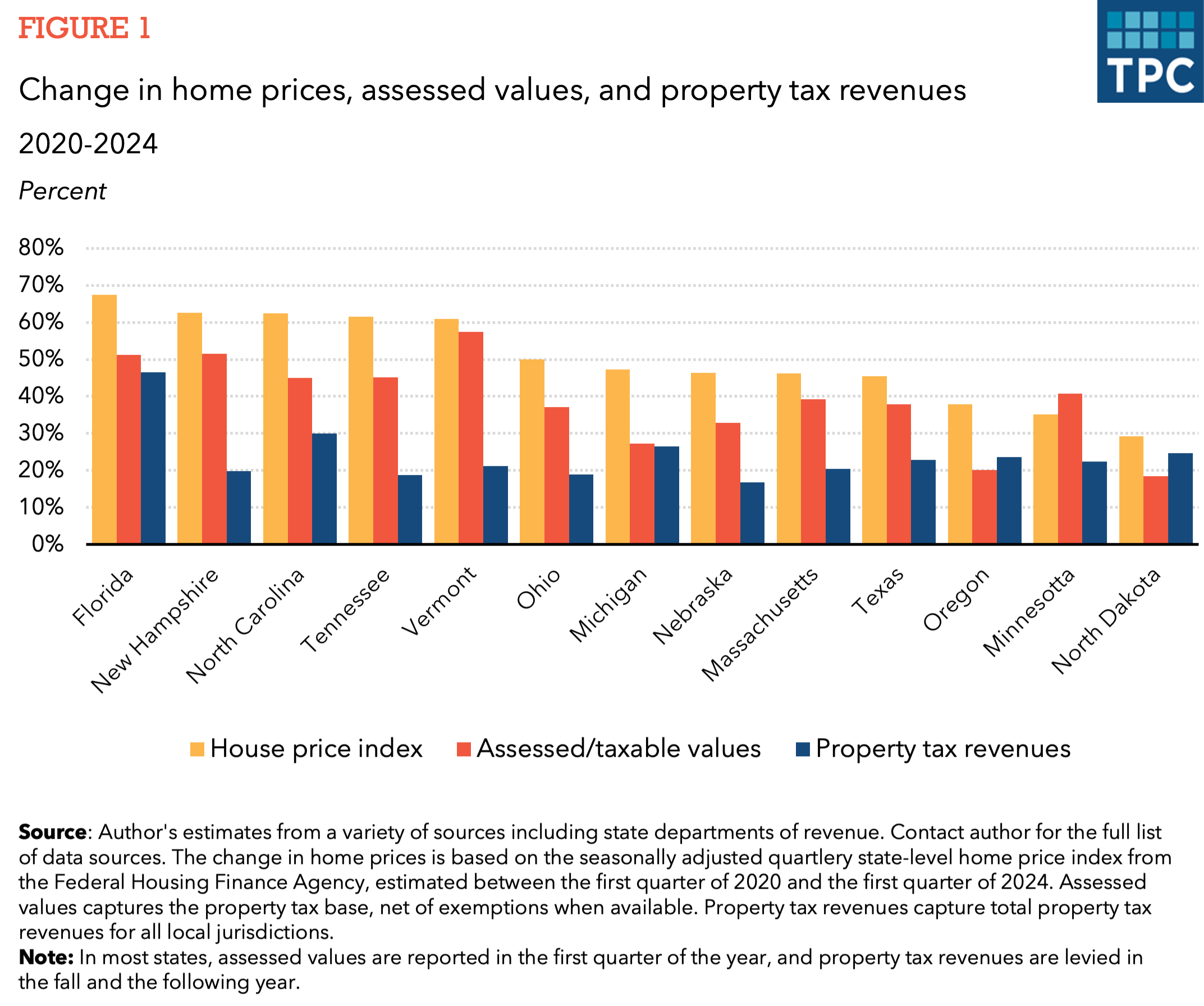
Figure 1 shows the complex relationship between property taxes and home values across 13 states. These include states with the highest (Florida, New Hampshire, Vermont, North Carolina, Tennessee) and lowest (North Dakota, Minnesota, Oregon) home price increases and states with strict property tax limits (Michigan, Massachusetts) as well as states where the property tax is currently being contested (Ohio, Nebraska, Texas).
In almost all 13 states, assessed values rose more slowly than market values, and tax revenues increased by less than assessed values, often only near or slightly above inflation. Policies played an important role in constraining the growth. In Michigan, for example, strict limits cap growth in taxable values and revenue, while in Massachusetts, a levy limit restricts revenue growth.
In other states, the modest increases may reflect local choices or political pressures. In New Hampshire and Vermont, both highly dependent on the tax, property tax revenues rose only slightly despite sharp increases in home values.
Florida stands out: both assessed values and tax revenues grew significantly, even though the state has a strict assessment limit on homestead property. This growth likely reflects population growth, new housing, and rising second-home values.
Is the property tax a “good” tax?
Homeowners often despise the property tax. It is salient, unpredictable, loosely tied to income, and sometimes unfair. Revolts are not new: the backlash of the 1970s and 1980s ushered in statewide limits, most famously California’s Proposition 13.
But today’s calls go further, to drastically reduce, or even abolish the property tax. In Florida, where home prices surged between 2020 and 2024, Governor Ron DeSantis (R) is pushing for a ballot measure to slash or eliminate the tax.
Yet economists and policymakers have many reasons to love the property tax. It is more reliable and stable than other taxes and government transfers. It is more efficient than income taxes, because taxing land and buildings—capital that can’t move—is less disruptive to economic decisions than taxing income. And, despite issues with assessment practices and debates on its regressivity or progressivity, it is usually more equitable than sales taxes or charges, the other two largest sources of locally raised revenue.
Eliminating the property tax would leave local governments with only two choices: cut essential services, especially K-12 education, which relies heavily on the tax, or hike other, less efficient and equitable taxes.
What should state and local governments do?
Rather than cut or abolish the tax, governments could pursue reforms that protect homeowners while preserving revenue. These do not include property tax limits, blunt and inefficient tools that create large inequities, lower mobility, and harm local fiscal flexibility.
Lawmakers have better policy options:
- Adopt Truth in Taxation requirements. These laws require localities to disclose property tax increases, hold public hearings, and sometimes require a vote by the governing body when revenues rise above a set threshold. This promotes transparency and accountability.
- Use circuit breakers. These target relief to households for whom property taxes consume a large share of income, offering protection without across-the-board cuts.
- Expand homestead exemptions. By reducing the taxable value of primary residences, exemptions offer progressive relief and mitigate regressive assessments.
The property tax is far from perfect, but it is the foundation of local government and public K-12 education finance. Scrapping it would create more problems than it solves. A better path is to manage volatility when home values surge and protect vulnerable homeowners, while ensuring communities can still fund essential services.