

The earned income tax credit (EITC) lifts millions of US households out of poverty each year. Its success in rewarding working individuals has spurred the District of Columbia and 31 states, including Maryland, to create their own state-level EITCs.
But claiming federal and state tax credits can be complicated. According to the IRS, one in five eligible US households do not claim the federal EITC. And since state-level EITCs have similar rules and filing requirements to those of the federal credit, there are likely uptake gaps there as well.
The Urban Institute, in partnership with the Comptroller of Maryland, is researching where and why households may be missing out on the state’s tax credits for which they are eligible. With this information, Maryland leaders can target outreach and tax filing support to those who need it most.
Who may be missing out on Maryland’s EITC?
To claim the federal or state EITC, a taxpayer must file a tax return. Besides meeting income criteria, families with children must sort through various relationship and residency rules. Prior research has shown that households that do not receive the federal credit may be unaware they are eligible for the credit or are discouraged by the tax credit’s complex rules.
According to the IRS, people likely to be missing out on the federal EITC include those who live in rural areas, are self-employed, receive disability income or have children with disabilities, do not have a qualifying child, are not proficient in English, or are grandparents raising grandchildren.
While the federal government has identified key groups at risk of missing out on the EITC, similar insights are often lacking at the state level. In Maryland, the Urban Institute is working with the Comptroller to better understand who may not be accessing state-level tax credits for which they are eligible and what the state can do about it.
Using data from the Maryland Comptroller, we learned that about 97,000 households that filed a tax return and appeared eligible for the state-level EITC in tax year 2023 did not claim the credit. That amounts to 18 percent of the estimated 550,000 eligible Maryland taxpayers.
That 18 percent is likely an underestimate because it excludes non-filers—who, according to IRS research, make up a large share of those who do not claim tax credits for which they are eligible. In many cases, those who do not file taxes are not required to because their incomes are too low.
A significant share of taxpayers that appeared eligible for the credit but did not claim it in 2023 were Marylanders with Individual Taxpayer Identification Numbers (ITINs), typically “mixed status” families with both documented and undocumented members. Maryland’s credit is available to these families if they meet the income eligibility and other qualifications. But prior research shows ITIN filers face barriers learning about credits and filing tax returns.
Most eligible tax filers not claiming Maryland’s EITC live in six counties
From 2020 to 2023, the highest numbers of tax filers eligible for the state EITC but not claiming it lived in the following areas:
- Baltimore City (also a county)
- Baltimore County
- Montgomery County
- Prince George’s County
The highest shares of tax filers eligible for the EITC but not claiming it lived in:
- Kent County
- Howard County
- Montgomery County
- Prince George’s County
Montgomery County and Prince George’s County had both high numbers and shares of tax filers likely eligible for the state’s EITC but not claiming it. Kent County stood out as the only rural county among the areas with the highest non-claiming rates. About one in five eligible tax filers in Kent County likely missed out on benefits in 2023, slightly higher than the state average.
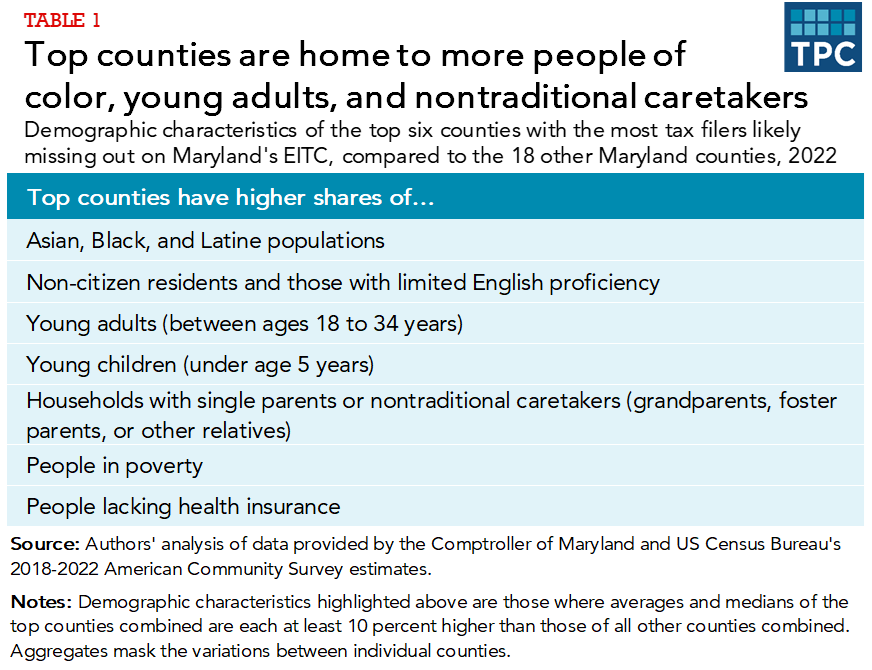
Overlaying US Census Bureau data with Maryland tax data allowed us to compare the demographics of these six counties to the rest of the state. Certain patterns stood out, suggesting that some communities may face distinct informational and tax filing barriers in accessing tax benefits (Table 1). In Prince George’s County, for example, over 20,000 tax filers were likely eligible for the EITC in 2023 but didn’t claim it. Census data indicate that this group may include large numbers of people of color, non-citizen residents, and single parents or nontraditional caretakers (such as grandparents, aunts, or uncles).
Leaders can use this information to design better outreach and tax filing strategies for their communities
Our findings align with prior literature on which U.S. residents are disproportionately missing out on tax credits like the EITC and the Child Tax Credit. This indicates the need for new strategies to help all people access the benefits for which they are eligible.
However, Maryland, like many states, is navigating growing fiscal uncertainty. In this context, effective use of limited government resources is all the more necessary.
This project, in partnership with the Comptroller of Maryland, aims to do just that. Through data analysis and community engagement, it seeks to uncover administrative and policy lessons for designing and delivering tax credits more effectively—insights that can help leaders across the country ensure eligible tax filers receive the tax benefits they have earned.