

The 2025 Budget Reconciliation Act introduced two new income tax deductions for tip income and overtime pay, mostly benefiting a small share of middle- to higher-income workers.
The 2025 Budget Reconciliation Act, also referred to as the One Big Beautiful Bill Act (OBBBA), created two new, temporary individual income tax deductions: one for a portion of workers’ tip income and one for a portion of their overtime pay. Both were promoted as relief for working Americans amid rising living costs.
Our estimates show the deductions reach a small share of taxpayers, provide larger benefits on average to higher earners than to the lowest-income workers, and carry a substantial revenue cost if extended past their scheduled 2028 expiration.
How Do the Tips and Overtime Deductions Work?
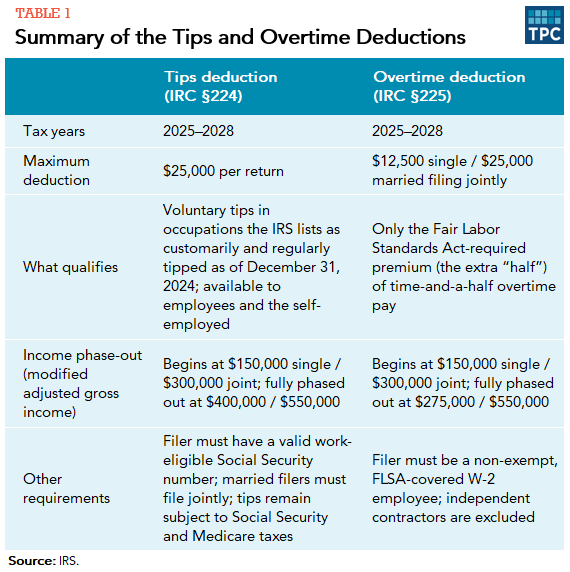
Both provisions are structured as above-the-line deductions that reduce the taxable income base, rather than tax credits that reduce tax owed directly. They are available for tax years 2025 through 2028, and phase out at higher incomes (Table 1).
The tips deduction applies only to voluntary tips earned in occupations the IRS designates as “customarily and regularly tipped” as of December 31, 2024, and both employees and the self-employed may claim it.
The overtime deduction applies only to the Fair Labor Standards Act (FLSA)-required premium portion of overtime pay, the extra half of time-and-a-half pay, and not to a worker’s full overtime earnings. Only FLSA-covered, non-exempt W-2 employees qualify; independent contractors cannot claim it.
Who is Eligible, and Who Actually Benefits?
Because both provisions are tax deductions, and not tax credits, a worker with little or no federal income tax liability receives little to no benefit, regardless of how much tip or overtime income they earn. This often occurs because the standard deduction reduces the amount of income that is subject to federal income taxes, and nonrefundable credits reduce the amount of income taxes owed to zero.
Eligibility rules limit the reach of each deduction: the tips deduction applies only to those in the IRS’s qualifying list of occupations that customarily and regularly received tips, so two workers with similar tip income can be treated differently depending on their employer or occupation.
The overtime deduction excludes independent contractors, gig workers, and FLSA-exempt employees.
Only tips reported on tax returns can be deducted from taxable income. The remainder already go untaxed, limiting the overall impact of this deduction. As of tax year 2006, unreported tips totaled $23 billion, comprising 52 percent of estimated individual tip income ($44 billion).
TPC estimates that 3 percent of taxpayers benefit from the tips deduction, with an average tax reduction of about $1,480 among those who benefit, and that 10 percent of taxpayers benefit from the overtime deduction, with an average tax reduction of about $1,200. More than 90 percent of taxpayers in the bottom 40 percent of the income distribution benefit from neither provision.
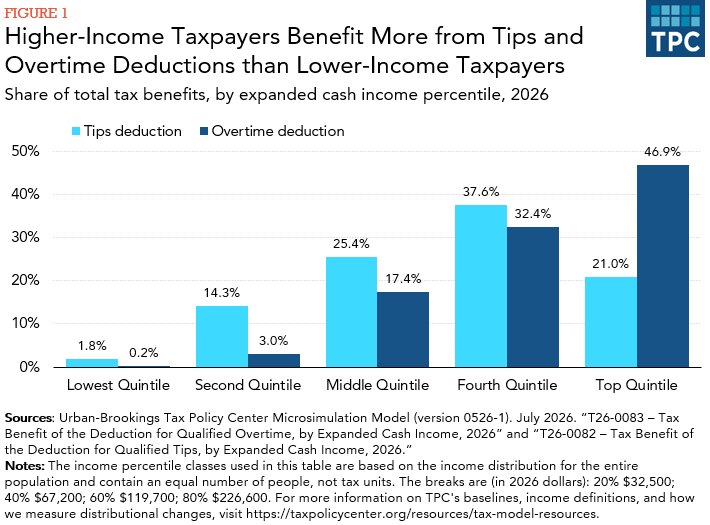
Benefits of these two tax provisions are concentrated among households in higher income quintiles, with 47 percent of the benefits of the overtime deduction and 21 percent of the benefits of the tips deduction going to the top quintile of households (Figure 1). This is likely because deductions are worth more to filers in higher tax brackets and because higher earners are more likely to have enough taxable income to benefit from the full deduction amount.
What Do the Deductions Cost?
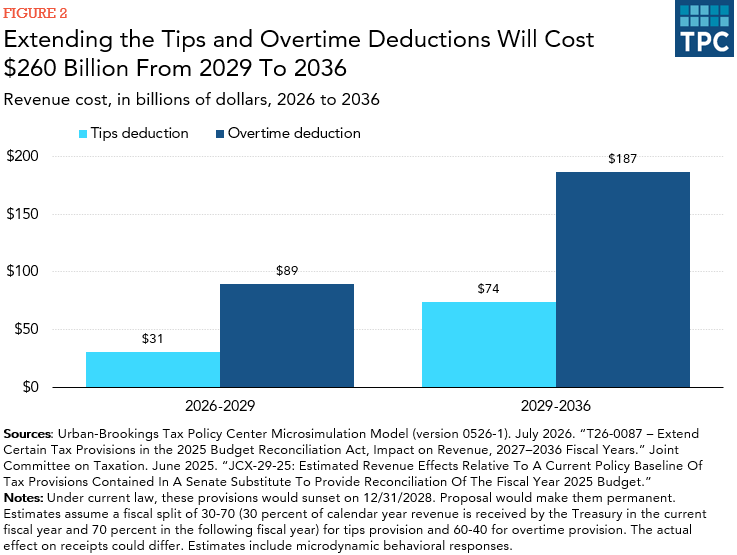
The Joint Committee on Taxation estimated that the tips deduction would reduce federal revenue by about $30.8 billion and the overtime deduction would reduce federal revenue by about $89.2 billion from fiscal years 2026 through 2029 (Figure 2). Both are scheduled to expire after 2028. TPC estimates that extending these provisions through 2036 would add an estimated $260 billion in additional cost over that period.
Updated August 2026
Mathur, Aparna. 2026. “Tip and Overtime Deductions Won’t Solve America’s Affordability Crisis.” TaxVox (blog). Washington DC: Urban-Brookings Tax Policy Center.
Urban-Brookings Tax Policy Center. 2026. “T26-0092 – Distribution of Tax Units That Pay No Individual Income Tax, 2026.” Washington DC.
Urban-Brookings Tax Policy Center. 2026. “T26-0087 – Extend Certain Tax Provisions in the 2025 Budget Reconciliation Act, Impact on Revenue, 2027–2036 Fiscal Years.” Washington DC.
Urban-Brookings Tax Policy Center. 2026. “T26-0083 – Tax Benefit of the Deduction for Qualified Overtime, by Expanded Cash Income, 2026.” Washington DC.
Urban-Brookings Tax Policy Center. 2026. “T26-0082 – Tax Benefit of the Deduction for Qualified Tips, by Expanded Cash Income, 2026.” Washington DC.
Holtzblatt, Janet. 2025. “When More Is Less: Treasury’s Tax-Exempt Tip Guidance Can’t Fill Legislative Gaps.” TaxVox (blog). Washington DC: Urban-Brookings Tax Policy Center.
Joint Committee on Taxation. 2025. “JCX-29-25: Estimated Revenue Effects Relative To A Current Policy Baseline Of Tax Provisions Contained In A Senate Substitute To Provide Reconciliation Of The Fiscal Year 2025 Budget.” Washington DC.