

Headlines often tell a simple story: Taxpayers are fleeing high-tax states like California and New York for no-income-tax states like Florida and Texas. But a deeper dive into the latest IRS data on taxpayer moves and the broader forces that drive migration decisions reveals a more nuanced picture.
IRS data cannot measure exactly when or why taxpayers move
IRS migration data draw on address changes reported on individual income tax returns. The latest release is based on Forms 1040 filed and processed during calendar years 2022 and 2023. As the IRS notes, returns received in 2023 represent income earned in 2022, while returns received in 2022 reflect income earned in 2021.
Importantly, the data do not identify the exact date when a move or address change occurred. For taxpayers filing returns in early 2023, many moves likely took place during calendar year 2022. However, some taxpayers may have moved in early 2023 before filing, while others who filed extensions for tax year 2022 may have moved later in 2023. In addition, the address reported on a tax return may not fully reflect where income was earned or where a household’s broader economic activity was located.
The IRS migration files also come with specific definitions, limitations, and occasional methodological changes. For the latest release, the IRS improved the process used to match tax returns across years, which increased the number of returns included in the migration dataset by approximately 5 percent and may affect comparisons over time.
IRS data also can’t reveal why people move. According to a United Van Lines 2025 survey, the most common reasons for moving are family (29 percent), a new job or transfer (26 percent), and retirement (14 percent). People are also more likely to move at retirement or when they have the financial flexibility to relocate.
Massachusetts shows the risk of overclaiming
Recent headlines have pointed to the IRS data to say “millionaires took $4.2 billion” out of Massachusetts in 2023 due to a 4 percent surtax which took effect January 1, 2023. However, it’s important to remember the IRS migration data group taxpayers into broad income categories, such as those with more than $200,000 of adjusted gross income (AGI). This group is far larger than the subset of taxpayers subject to the surtax, which applies only to income above $1 million of taxable income.
More importantly, the underlying migration counts tell a different story. The data show that the net loss of taxpayers from Massachusetts was larger in the 2021–2022 file than in the 2022–2023 file, both for all taxpayers and for those with incomes above $200,000.
If the surtax were driving migration, we would expect to see an increase in net losses, not a decline. Similarly, the net AGI loss reported in 2023 was smaller than in 2022, further undercutting claims of a growing exodus attributed to the surtax.
More broadly, AGI flows are influenced by many factors unrelated to migration, including the timing of income realization and reporting behavior. For these reasons, migration data—especially AGI flows—should not be treated as direct evidence that tax policy changes are driving relocation decisions.
IRS data reveal more nuanced migration patterns
Underlying migration rates show how misleading the “high-tax to low-tax” narrative can be. In 2022, more New York filers moved to nearby New Jersey and Connecticut, both relatively high-tax states, than to Florida or Texas. Moves from New York to high-tax states like California and Connecticut also exceeded those to no-income-tax states like Texas.
Washington saw the same trend. Despite having no broad-based individual income tax, many departing taxpayers moved to higher-tax states like California and Oregon, suggesting migration reflects regional labor markets and economic ties, not just lower taxes.
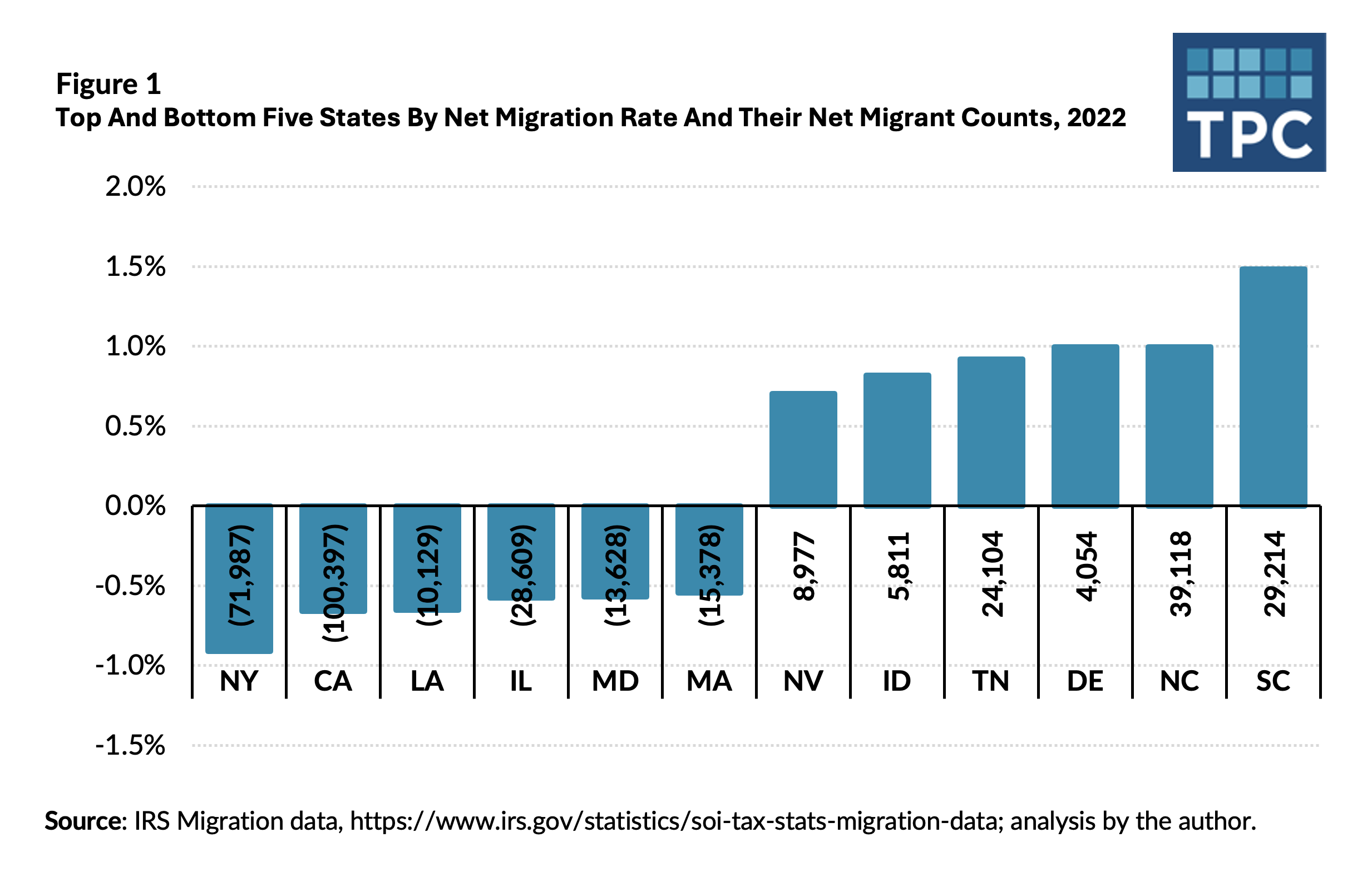
By migration rate, neither Florida nor Texas—both of which have no state income tax—ranks among the top five receiving states. As Figure 1 shows, South Carolina gained the most residents in 2022, followed by Delaware and North Carolina, underscoring that housing costs, labor markets, and services, not just tax policy, drive relocation decisions.
The IRS data do not justify a simple headline that taxpayers are fleeing high-tax states for low-tax ones. At best, they show where filers go, not why or exactly when. Taxes matter at the margin for some households, but IRS data alone cannot tell that story. They are best used as a starting point for analysis, not proof of a tax-driven exodus.