

Some of President Trump’s steepest tariffs target steel and aluminum, which both currently face 50 percent import levies. But who really pays that extra 50 percent?
Tariffs are assessed on US companies that import goods, but evidence indicates that those costs rarely stop there. Importers pass tariff costs to their business customers, who often pass them along again, eventually reaching consumers or other end users. The tricky part is figuring out who end users are when the import is something widely used like steel.
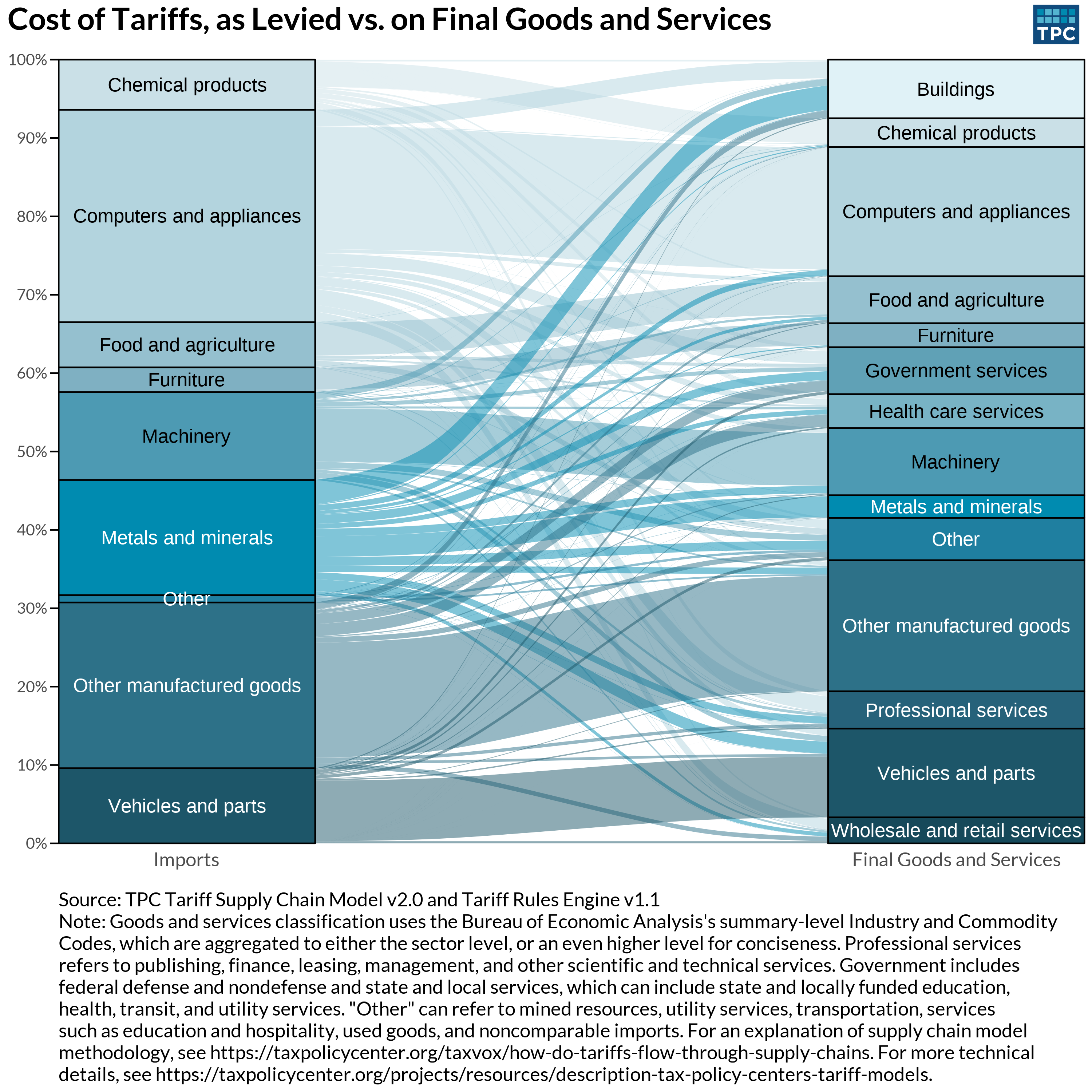
TPC estimates that once you track how tariffed inputs ripple through supply chains—or account for end uses—almost one-third of their burden lands on goods and services that aren’t directly tariffed (Figure 1).
FIGURE 1
Tracking a tariff requires tracking the use of an imported good
Most goods can be both intermediate (a good used to produce something else) or final (immediately used). Consider again imported steel. If a person orders a steel grill press online, that press is a final good. However, if a construction company orders I-beams to erect a building, the steel in those beams is an intermediate good.
Understanding the incidence of a tariff on that steel or any good requires a picture of how and when goods are used in the production of other goods. Adapting the Bureau of Economic Analysis’ input-output framework, TPC’s Supply Chain Model provides that picture. The model:
- Separates each good’s use into final versus intermediate uses.
- Traces intermediate inputs through production chains, including goods used to make services and services used to make goods.
- Accounts for each stage of production. For example, if an automobile requires tires, TPC’s Tariff Supply Chain Model considers the steel machinery required to create them. The tariff on the steel in the machinery increases the machinery’s cost, which increases the cost of the tires, which increases the cost of the automobile.
- Distinguishes among final uses, such as private consumption, private investment in intellectual property, residential investment, federal defense investment, and state and local investment in structures.
Tariff exposure is broad
These calculations map how tariff costs move through supply chains, revealing how much of the burden ends up in different goods and services (Figure 1).
About four-fifths of tariff burden on metals and minerals ultimately ends up on other goods and services. The same is true for substantial portions of tariff burden on computers and appliances, and on chemical products.
Some goods, such as food and furniture, have straightforward tariff impacts, with minimal difference between their share of upstream and downstream burden. The burden on vehicles, on the other hand, grows by a fifth after their uses of intermediate goods are accounted for. Much of this additional burden comes from metals and minerals.
Services as a group pick up about one-sixth of total tariff burden, even though tariffs are not directly applied to services. This is because metals and minerals, chemical products, and computers and appliances are heavily used as inputs by health care, professional, and government services. Building construction also uses metals and computers as well as appliances extensively, in addition to machinery.
The economy is complex, so is the impact of tariffs
Simple stories about who wins or loses from tariffs miss the complex reality of how tariff costs move through the economy. The standard view is that tariffs benefit domestic businesses and that the main risk is retaliatory tariffs, although recent experience shows limited retaliation.
TPC’s analysis shows that even without retaliatory tariffs, many American products are burdened by US tariffs even when producers or investors do not import directly or realize they rely on imported inputs.
The US economy is complex network of specialized, interdependent industries. When tariffs raise costs in one part of the supply chain, those costs can ripple outward, landing in places one might not expect.