

Tax credits can reduce economic hardships for households with low and moderate incomes. Yet, each year people who are eligible for tax credits like the Child Tax Credit (CTC) and the Earned Income Tax Credit (EITC) do not claim them, essentially leaving money on the table.
In an ongoing collaboration with the Comptroller of Maryland, the Urban Institute interviewed 19 government and non-profit leaders engaged in tax outreach or tax filing services. The goal was to understand the challenges Marylanders face in accessing the state’s EITC and CTC and to explore potential solutions. They reported that enhanced outreach, support from trusted messengers, and wider access to free tax filing services can help ensure more eligible households claim the tax benefits they have earned.
Outreach campaigns must foster trust and be creative
Building trust between service providers and the people they serve is essential to effective outreach about tax benefits, because community members are more likely to be receptive to information that comes from people and organizations they know. That effort will look different across communities and groups of people. For example, in rural areas, building trust may mean consistent and regular interactions over long periods of time. For immigrant communities, it may mean providing culturally competent and multi-lingual services.
To ensure families are connected to tax benefits, past research has shown the value of trusted messengers, like faith-based leaders, school staff, or local non-profit organizations (Figure 1). Trusted messengers have deep connections to their communities and are seen as consistent and reliable sources of information.
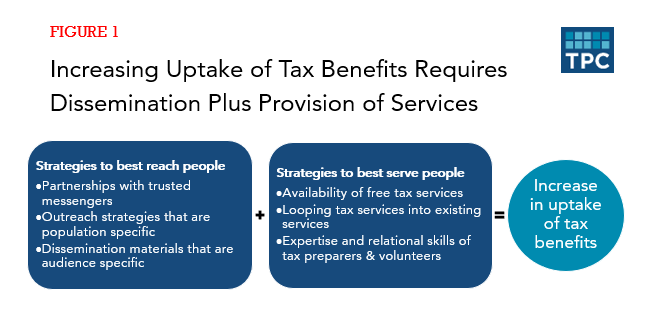
Trusted messengers can also help determine outreach strategies that best fit a particular group. For example, older adults may not respond as well to online materials if they have less familiarity with technology or fear being scammed. As one expert shared:
“In more rural areas [...] seniors have finally been trained to avoid scammers as much as possible. But now they hang up the phone, they don't trust anything they see on the Internet [which can be challenging].” - Non-profit leader
Successful outreach strategies require creativity. That may include social media posts, newsletter reminders, cable TV or radio ads featuring trusted messengers, multilingual brochures and flyers, one-on-one conversations, and community-facing events. (Figure 1). Participants in our interviews consistently reported the key to reaching people is having a variety of materials and approaches with clear and easy-to-understand presentation.
“I have African communities. I have Korean communities. I have Chinese communities, Indian communities, and Hispanic/Latino communities. This is a huge cake, right? I'm in charge to make sure that these communities understand taxes in their language.” - Government leader
Tax preparation services should be free and high quality
Outreach efforts to inform people about tax benefits go hand in hand with providing effective free tax filing supports. That can mean bringing tax clinics to the places people already frequent, like Social Security offices or healthcare facilities, and sharing tax resources in other government offices.
“Most people don't really care what government agency you're from. They don't care if you're from the Comptroller's Office or DHS, they just want some help [and information]: they want to get the money they're owed or they're trying to figure out how to untangle the bureaucratic mess that they're in.” – Government leader
But even this might not be enough. Outreach workers and tax preparation professionals and volunteers need training not only in tax preparation but also in interpersonal skills in order to most effectively engage residents. With the right support, they can help clients feel more at ease when discussing sensitive financial topics and be better equipped to explain what they did for the client’s tax return (e.g. whether they claimed the standard deduction or itemized deductions) and why they did it (e.g. explaining the benefits of different approaches).
Interpersonal skills are especially important when providing free tax services in unusual settings, like a healthcare facility where people are not necessarily thinking about taxes. This is why tax clinics should train preparers to work with different kinds of filers, including immigrants or people experiencing homelessness, among others. As one expert shared:
“Popping up and walking up to somebody you don't know and being like, ‘share your information with us so we can help you with your taxes’ is a wild way to start a conversation, right? And I’ve seen our families find that very abrasive.” – Non-profit leader
There is opportunity in cross-sector collaboration and strategic funding
Our conversations revealed areas of opportunity to improve uptake (Figure 2). For example, stakeholders noted that strategic, stable funding for non-profits and government agencies doing tax outreach and providing free tax preparation services is essential to maintaining service capacity and building trust over the long-term. Compared to one-time boosts, sustained investment can help build the infrastructure and staffing needed to reach more eligible households consistently.
“If I had a magic wand and all the money in the world, I would literally create, you know, [bigger] regional public engagement offices where I would have 5 people [each], and I would have 15 people in Prince George's County, Montgomery County and Howard County alone” – Government leader
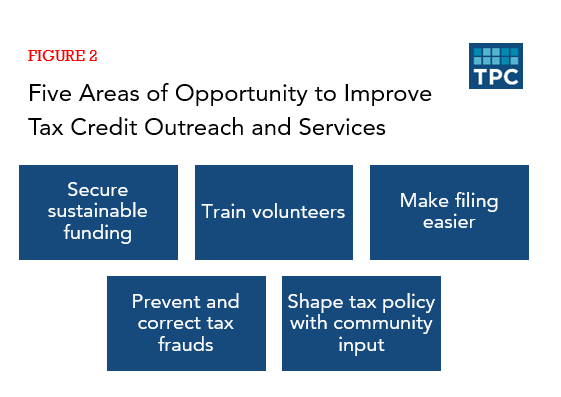
Some recent policy changes in Maryland may bolster tax credit uptake, such as a requirement for employers to notify eligible employees about tax credits and new state resources for the Comptroller of Maryland’s Tax Eligibility Awareness Campaign.
Our interviews also suggested that further coordination between state and local government agencies, and expanded engagements with non-profit organizations, is likely to improve tax credit uptake in the coming years. Hearing directly from individuals and families who are facing difficulties in accessing tax benefits also has strong potential to inform more effective solutions.