

Oil prices are rising again, driven largely by ongoing geopolitical tensions and uncertainty in global energy markets. Their effects are already moving beyond energy markets and into state budgets, household finances, and policy debates.
Oil price swings can reshape state budgets quickly, especially in oil-producing states that rely heavily on severance taxes. But even in non-oil-producing states, higher oil prices raise the costs of government services and squeeze household budgets.
In both kinds of states, policymakers should remember that oil price increases are usually followed by declines. In oil-dependent states, those downturns can quickly weaken revenues, jobs, and broader economic activity. In states without significant oil production, rising prices may prompt calls for gas tax holidays—but lawmakers would do well to instead focus on policies that strengthen families’ long-term economic security.
For oil-producing states, booms bring windfalls and busts bring pain
The sharpest effects of oil price swings show up in the nine oil-producing states that depend heavily on severance taxes: Alaska, North Dakota, New Mexico, Wyoming, Oklahoma, West Virginia, Texas, Montana, and Louisiana. In 2022, when oil prices surged, severance taxes accounted for roughly one-fifth of total state tax revenue across these states, compared to about 2 percent nationally (Figure 1).
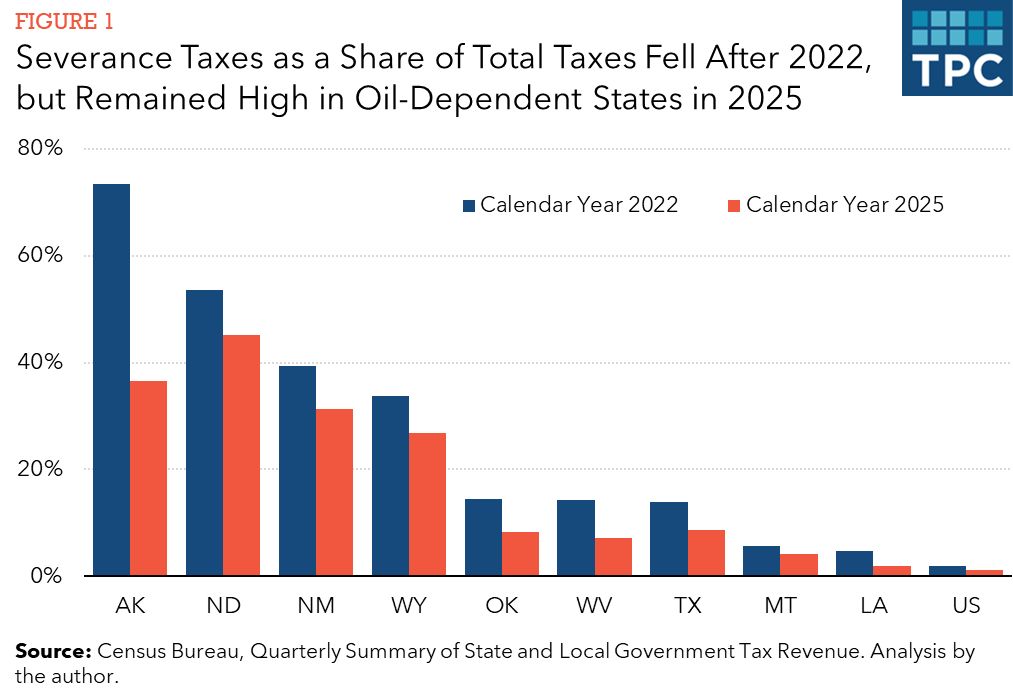
In four oil-producing states, the dependence was even more pronounced: well over half of Alaska’s and North Dakota’s total tax revenue came from severance taxes in 2022, while New Mexico and Wyoming relied on these taxes for more than one-third of their revenues.
Just as important to remember: Oil-producing states are also exposed when prices fall. During the shale boom in the early 2010s, revenues surged in some oil states, and when oil prices later fell, those gains disappeared quickly. In 2022, some oil-producing states experienced outright declines in total tax revenue even as collections continued to grow in most other states.
Inflation tends to follow oil price spikes, affecting affordability and state budgets
Most other states do not experience direct revenue swings from oil prices, but they and their residents still face higher costs when oil prices jump.
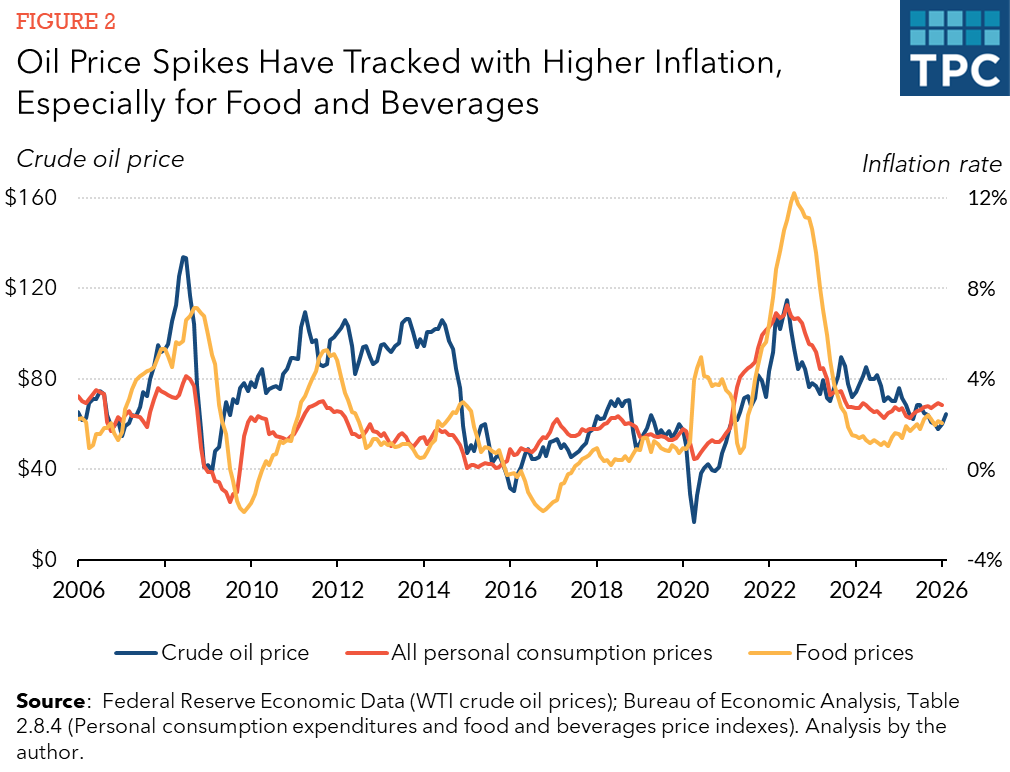
Figure 2 shows how major crude oil price spikes in 2008 and again in 2022 were accompanied by noticeable increases in food and beverage inflation, beyond overall inflation. That reflects the energy-intensive nature of food production and distribution as well as lingering supply chain disruptions from the COVID-19 pandemic.
Food and energy price increases are especially hard on lower-income households, for whom these costs make up a larger share of total spending.
For state governments, rising inflation translates into higher costs across the board, from construction and infrastructure to public services and procurement. Higher prices can also dampen consumer spending, reducing sales tax collections. Even when sales tax revenues increase in nominal terms due to increased prices, they may not keep pace with rising costs, especially if consumer behavior shifts.
Oil price spikes can lead states to offer gas tax holidays, reducing revenue and offering limited relief
In 2022, several states – Connecticut, Florida, Georgia, Maryland, and New York – moved quickly to provide relief through temporary suspensions of motor fuel taxes at a cost of about $2 billion. The impact varied by state, ranging from $90 million in Connecticut to over $1 billion in Georgia.
Additional states, including Colorado, Illinois, and Kentucky, suspended scheduled gas tax increases, further reducing transportation-related revenues.
But motor fuel taxes are a key source of funding for transportation infrastructure. Temporarily suspending them or forgoing planned increases means either delaying projects, reallocating funds, or tapping reserves.
And evidence suggests that gas tax holidays do not fully translate into lower prices for consumers, as some of the benefit is absorbed within the supply chain. As a result, they deliver limited consumer relief while still reducing state revenues.
Repeating 2022’s gas tax holidays may be harder in 2026
The state policy response in 2022 was shaped by an unusually strong fiscal environment. Robust revenue growth and budget surpluses followed the pandemic, thanks largely to temporary factors and substantial federal aid. State budgets could absorb the cost of temporary gas tax relief.
Today, the fiscal landscape looks different. Revenue growth has substantially weakened in many states, and budget pressures are returning. Policymakers may be more cautious about forgoing dedicated revenue streams, even as fuel prices climb again. Florida Governor Ron DeSantis (R) has already rejected calls for gas tax suspensions, while others are revisiting the idea.
Rising oil prices create winners and losers, and states need to be prepared
Oil price volatility is a persistent feature of the economic landscape. The difference between fiscal stability and fiscal stress will come down to how well states prepare for the swings.
In some states, falling oil prices can slow entire economies, as commercial activity, employment, and other tax revenues, such as income and sales taxes, weaken. To smooth volatility over time, some oil-producing states channel severance tax revenues into permanent funds, such as Wyoming’s permanent mineral trust fund.
For the other states, higher oil prices bring added costs but no corresponding revenue boost.
And in all states, effects on residents are uneven. Lower-income households and rural communities tend to spend a larger share of their income on energy and food, making them more vulnerable to price increases.
The tension between political pressure for short-term relief and fiscal need for long-term stability isn’t easing any time soon.