

As state and local governments face growing fiscal uncertainty and shifts in federal policies, they may seek more revenue from fines and fees in the criminal legal system. But this strategy may do more harm than good.
New data from the Urban Institute’s nationally representative Well-Being and Basic Needs Survey suggests that fines and fees may fail to generate significant revenue compared to other sources, like income, sales, or property taxes. A new TPC report illustrates how expanded reliance on fines and fees, also known as legal financial obligations, could deepen financial hardships among residents without meaningfully improving state and local budgets.
Who faces fines and fees, and why?
Nearly one in five working-age adults reported that their households were charged fines or fees in 2024, a rate consistent with the prior year. Traffic and parking tickets were the most common. Court- or incarceration-related costs, while less prevalent, were far more financially burdensome.
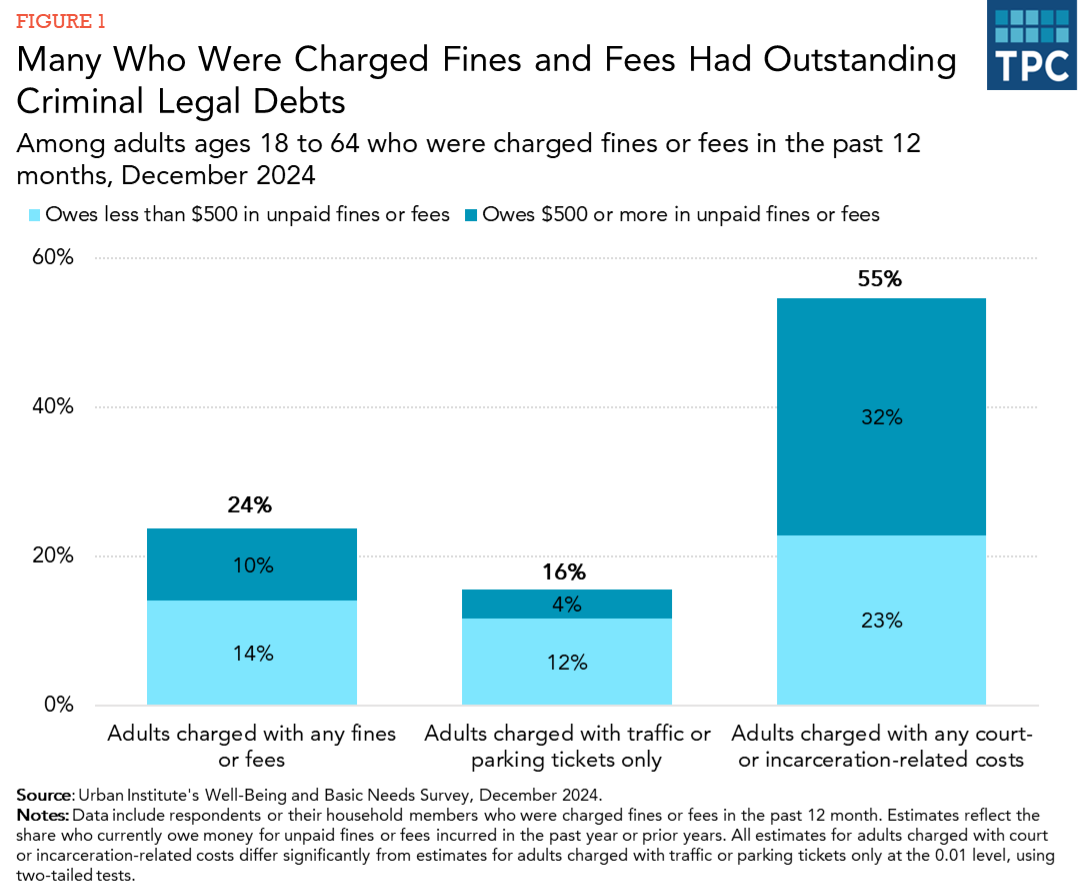
Over half of adults who incurred any court- or incarceration-related costs were charged $500 or more, compared to just seven percent of those who received tickets only. These amounts can push not just individuals – but their families too – to forgo basic necessities, withdraw savings, increase credit card debts, and take out loans in order to pay fines or fees.
Fines and fees may be unaffordable for many
About one in four adults who were charged fines or fees in 2024 reported that they owed money for unpaid fines or fees from that year or prior years (Figure 1). Among those who incurred any court- or incarceration-related costs, this rate was over twice as high (55 percent). Prior research shows that those who fail to pay down their criminal legal debts can be charged additional fines and fees, have their driver’s licenses suspended, and serve time in jail.
The Urban Institute survey further revealed the depth of financial strain from fines and fees. It asked those charged any fines or fees in the 12 months prior to December 2024 whether they were financially insecure, or not confident coming up with $400 for an unexpected expense. A quarter said yes, and among them, 27 percent were charged fine or fee amounts exceeding $500.
Importantly, fine or fee amounts are rarely scaled to people’s means: a $500 penalty may be inconsequential to some, but could be a serious financial burden for someone making only $15,000 a year. If fines and fees continue to be assessed without regard to people’s ability to pay, then state and local governments may worsen household debts while collecting little revenue because many households cannot afford to pay.
Court- or incarceration-related debts, in particular, could intensify financial strain: affected households reported high rates of food insecurity, housing and utility hardships, and difficulties affording health care for themselves and their families.
Despite these challenges, few survey respondents were asked by court or government staff about their ability to pay the amounts charged. Only five percent of those charged with or owing money for fines or fees said that staff inquired whether they had the means to pay them (Table 1). And, while one in four were offered some form of assistance, two-thirds of them received payment programs or installment plans that did not reduce the total amounts owed.
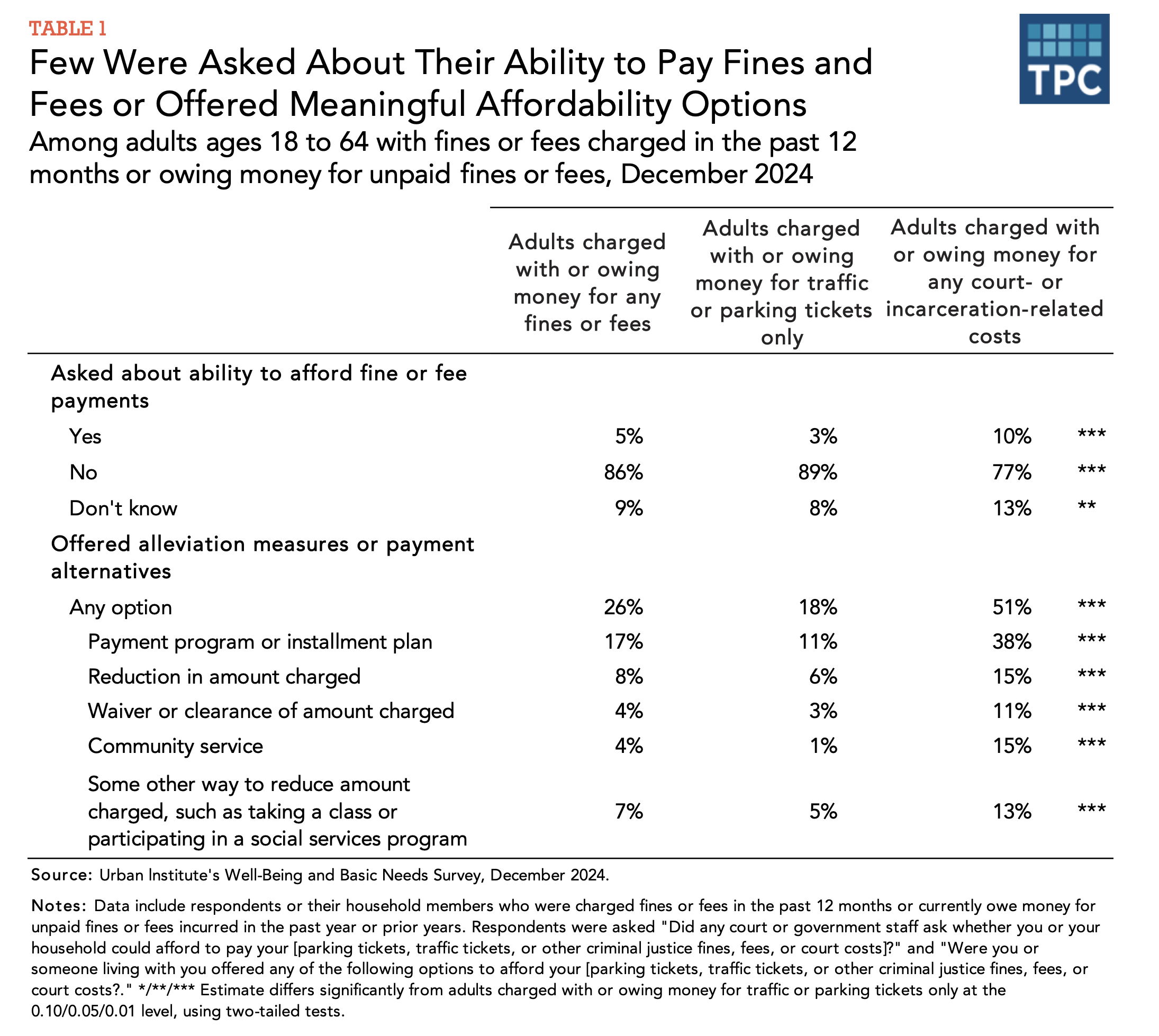
These findings echo prior research showing that fines and fees are often imposed without regard to ability to pay, leading to mounting debts and punitive consequences like license suspensions or jail. Research shows that fines and fees can further undermine health, affording basic necessities, ability to get to work, and ability to save for their children’s futures.
The fiscal incentives driving fines and fees trends are strong. The 2025 budget reconciliation bill included deep cuts to Medicaid and SNAP, shifting costs to states. With limited options to raise taxes, state and local governments may see “taxation by citation” as a politically palatable alternative, just as they did following the Great Recession of 2008.
But the evidence suggests this approach is not only regressive, but also inefficient. Prior research has shown that jurisdictions frequently collect less fines and fees than they charge, and may even spend more money enforcing these penalties than they generate in revenue. This can also erode trust in law enforcement and courts, diverting resources from core public safety functions.
Jurisdictions can improve their use of fines and fees
There are better pathways to deter future unlawful behavior and improve public safety with fines and fees. Some jurisdictions have begun assessing ability to pay, offering waivers, community service options, and forgiving long-standing debts. Right-sizing fines and eliminating administrative fees may also be prudent. This could reduce financial strain without compromising accountability and may even reduce recidivism.
The evidence shows that without accounting for people’s means, fines and fees will continue to deepen inequality and destabilize families while offering little revenue in return. Fines and fees practices that balance public safety and fiscal objectives with consideration for residents’ financial well-being could be fairer and more effective.