

Our new analysis shows that tax benefits continue to drive federal support for children, delivering about one third of all benefits to them. Tax benefits differ from more traditional spending programs in key ways—including eligibility, timing, participation, and administration—that shape how effectively they support families.
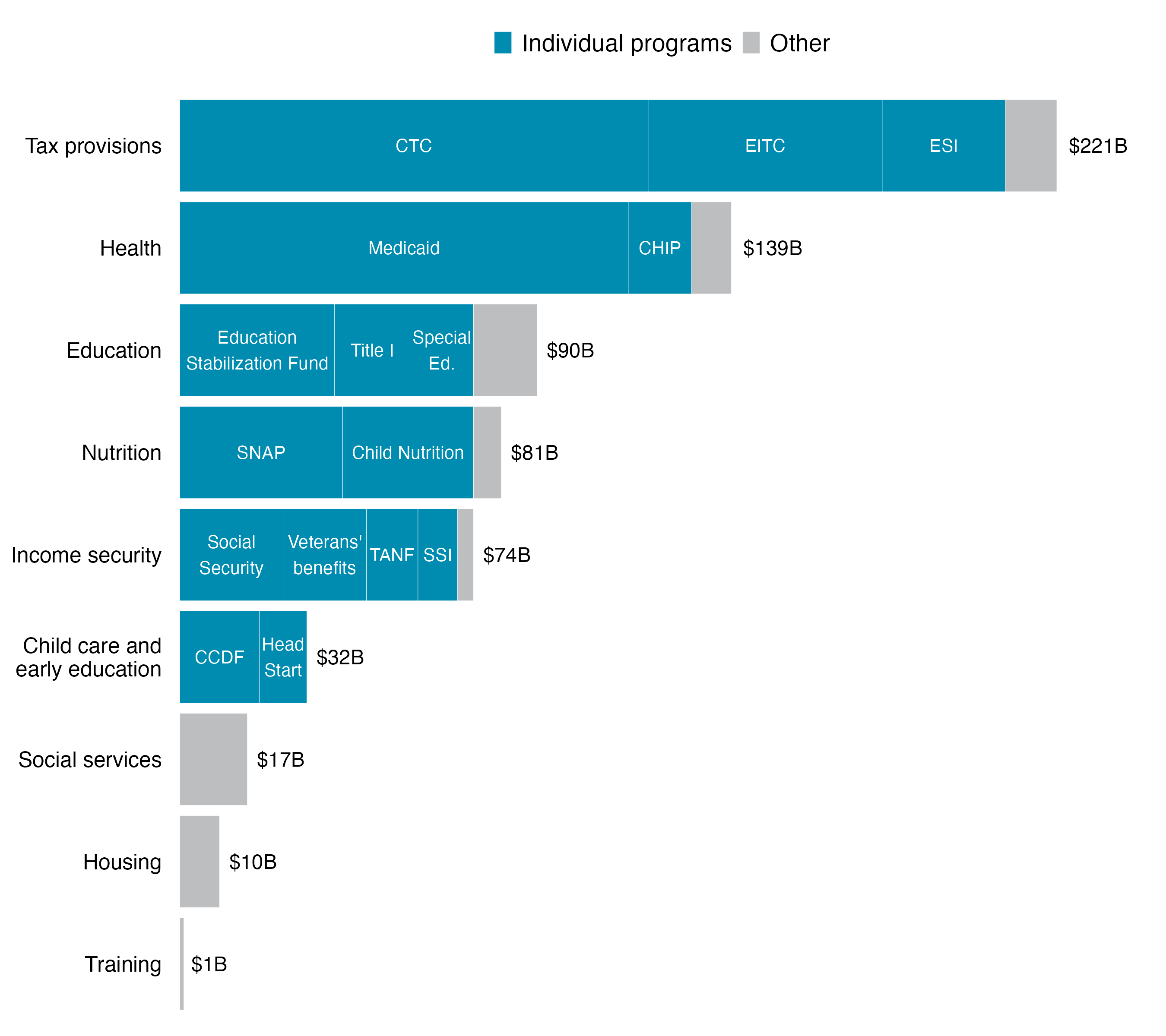
Federal expenditures on children by category and major programs in 2024, in billions of 2024 dollars
Sources: Authors’ estimates based primarily on OMB, Technical Supplement to the 2026 Budget: Appendix (PDF), (US Government Publishing Office, 2025).
Notes: Programs spending less than $10 billion are not shown separately but are included as part of “Other” and in the totals by category. These programs are listed in the notes for our accompanying table. CTC = child tax credit (including tax liability reductions and the refundable portion of the credit); EITC = earned income tax credit (including tax liability reductions and the refundable portion of the credit); ESI = exclusion from income tax on employer-sponsored health insurance; CHIP = Children’s Health Insurance Plan; SNAP = Supplemental Nutrition Assistance Program; TANF = Temporary Assistance for Needy Families; SSI = Supplemental Security Income; CCDF = Child Care and Development Fund.
The child tax credit (CTC) remains the largest single program supporting families with children, delivering $118 billion in benefits to children aged 18 and under in Fiscal Year (FY) 2024. Most of those benefits were delivered as a credit of up to $2,000 per child under age 17 with a Social Security number (SSN). The total CTC benefit amount here also includes the $500 nonrefundable credit for other dependents aged 18 and under.
Tax benefits reach more families, but are less targeted than other spending programs
Eligibility for the CTC is not limited to families with low and moderate incomes. Most families with children—90 percent—receive the CTC, far more than programs like Medicaid and the Supplemental Nutrition Assistance Program (SNAP, formerly food stamps). But unlike these spending programs, the CTC provides the smallest benefits, on average, to families with the lowest incomes. Though the One Big Beautiful Bill Act increased the CTC to up to $2,200 per child starting in 2025, families with the lowest incomes will not benefit from that increase.
In contrast, the earned income tax credit (EITC) supports primarily families with low and moderate incomes, providing an additional $59 billion in benefits to families with children aged 18 and under in FY 2024. More than one-third of families with children receive the EITC each year, and almost all the credit flows to families in the bottom 40 percent of the income distribution.
Other tax programs including the child and dependent care tax credit and the employer-sponsored health insurance tax exclusion deliver benefits mostly to families with high incomes.
Only one taxpayer is eligible to claim tax credits and generally that taxpayer claims all tax benefits associated with that child for the year—even though caregivers across multiple tax units may support a child over the course of a year.
Tax benefits are largely delivered annually, not necessarily when families need them most
Most people, particularly families with low incomes, receive tax benefits when they file a tax return, the year after they were determined eligible for them. Because family circumstances can change quickly, and because many families face monthly bills for food, housing, utilities, and child-related expenses, policymakers may want to reconsider how tax benefits are paid. In 2021, when Congress expanded the CTC, families received part of their benefit monthly, with low- and moderate-income recipients often spending it on food, clothing, utilities, schoolbooks, and supplies.
Tax benefits have higher participation rates than other spending programs
Tax benefits likely come with less stigma, compared to other programs for children. And claiming tax credits may be logistically easier than claiming other benefits: Most families with children already file a tax return for other reasons, but families generally have to complete an application or visit an office during traditional work hours to receive benefits outside the tax code. Even so, making sure all eligible families participate remains a key concern among tax credit administrators.
Tax benefits reach many children, but design choices shape their effectiveness
The tax system delivers one-third of all federal spending on children. Eligibility often extends to families with much higher incomes than other federal programs that support children. Benefits are typically delivered as part of a family’s annual tax refund and may not align well with families’ ongoing needs. On the other hand, eligible families are more likely to receive tax benefits than other types of benefits.
Policy makers should consider how these differences affect the effectiveness of support for children.