

The Urban Institute, in partnership with the Comptroller of Maryland, is studying what barriers to tax filing Marylanders face and how to increase uptake of the state’s tax credits. Prior de-identified tax data analysis and stakeholder interviews helped identify the types of households who may be missing out on tax credits and their counties of residence.
That evidence informed where and with whom to conduct focus groups across the state, with the goal of connecting directly with taxpayers about how to improve their access to tax credits. Convened in partnership with local community organizations, these focus groups allowed Marylanders to share their experiences of the tax system and shed light on how policymakers and other changemakers could improve it.
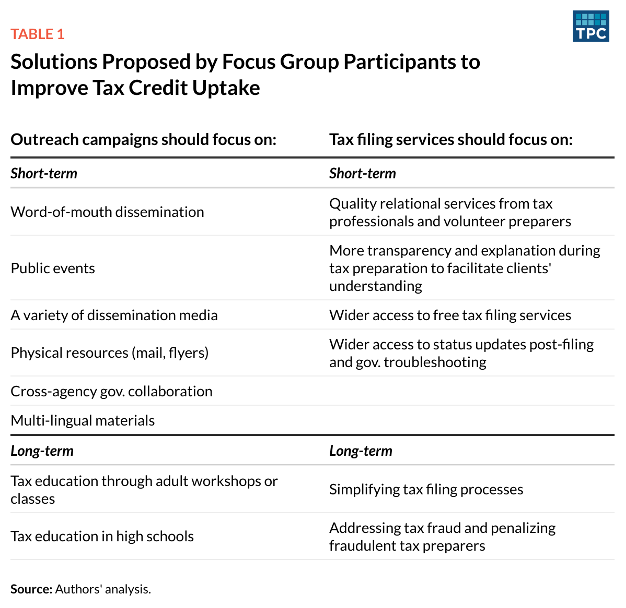
Participants in five focus groups highlighted several ways to improve tax credit uptake, including multi-modal and multi-lingual dissemination of information, more tax education opportunities for both children and adults, expanded access to high-quality free tax preparation services, and stronger partnerships between government and community organizations. We share insights from participants below, including their proposed solutions (Table 1).
More tax education could empower taxpayers
People shared how they filed state taxes and received tax refunds, but many were unaware of the Maryland-level earned income tax credit (EITC) and child tax credit (CTC). Differing eligibility rules between the federal EITC and state-level EITC is likely one reason for this confusion. For example, residents between the ages of 18 to 24 who have no children, and taxpayers with individual taxpayer identification numbers (ITINs), may be eligible for Maryland’s EITC, but not the federal version.
“I didn't know about the Maryland credits. It kind of goes back to what you were saying about information, right? Maybe there isn't enough information out there talking about these opportunities.” – Participant from Prince George’s County
Many participants expressed a desire to learn how tax credits work. They wanted to be better positioned to ask tax preparers the right questions, such as what their tax filing status is and why, what types of credits or deductions they qualify for, and why they did or did not receive a tax refund. Participants emphasized a desire for more time and transparency with their tax preparers, and noted that more tax-focused education in high schools or adult workshops would be helpful.
“But sometimes I still don't even trust my tax lady because why is she charging me close to $15 for something that I could do? So, I usually take notes. Like okay, ‘what does this mean, or what does this stipend mean for my children? I ask them questions on what they are putting down for dependents and stuff like that.’” – Young adult participant
Outreach campaigns should focus on tax filing services
During focus group interviews, Marylanders discussed their barriers to filing their taxes. Many did not know where to go, had difficulties paying for tax preparation services, or were afraid they would owe money for the current tax season or for past penalties. Others were confused about whether they had to file because they did not earn a lot, did not work during the year, or did not know the requirements for filing or receiving tax credits.
“Or [with] some employers now, you have to fill out your I-9 or W2. A lot of wording has changed since I started working at 15. So, I’m like ‘explain that to me’. And [the employers] are like, ‘oh, well, I can't help you with that because it's a federal form’. Yeah. So you don’t know what you're putting down.” – Young adult participant
Others mentioned being victims of fraud, which made them distrust the tax system and feel frustrated with government.
“People would feel empowered to be able to avoid being a victim of fraud. Accountants often charge us immigrants more, or they lie to us about the opportunities that are open to us, and we become victims of fraud.” – Non-citizen participant
Participants shared that increasing awareness of tax credits would require diverse approaches because different people trust different sources of information. For example, Black taxpayers and single parents told us they trusted local news, whereas young adults referenced social media. Effective dissemination avenues would include a mix of radio, social media/Internet, physical flyers, and government officials visiting public events.
"Put [tax information] on all the news channels. Guaranteed it'll get around because [...] everybody’s gonna watch at least one of the four channels, right?” – Participant from Baltimore City
Improving tax credit uptake in Maryland is possible with partnerships and education
The Comptroller of Maryland and other state-wide leaders have invested in initiatives to increase awareness and access to the state’s individual income tax credits. Still, each year, thousands of Marylanders, despite being eligible, miss out on these tax credits that could significantly improve their economic security and prosperity.
Findings from our focus groups, paired with prior data analysis and stakeholder interviews, have surfaced some initial strategies that could help policymakers improve uptake of the state EITC and CTC.
For example, government agencies conducting outreach could strengthen partnerships with local community organizations and local businesses, as well as trusted messengers who know their communities best (like nurses, faith-based leaders, or teachers), to facilitate tax filing services. Investment in long-term tax education initiatives, such as incorporating lessons on tax filing and tax credits in K-12 education, or hosting government or nonprofit-led tax workshops, could also assist with increasing uptake.
Focus group conversations show that Maryland’s government, non-profit, and corporate leaders can pursue a number of effective outreach, community engagement, and tax filing supports to close uptake gaps and improve the financial well-being of individuals and families. Marylanders are eager to get the benefits they have earned and to help shape the state’s solutions to increasing tax credit uptake.