

As states face fiscal pressures, advocates and researchers have in recent years cautioned that state and local governments may increase their use of criminal legal fines and fees for revenues. Fines and fees are generally not levied based on a person’s ability to pay, and the resulting debts can carry serious financial and legal consequences, with especially harmful impacts on Black households.
New state and local finance data confirms those warnings may have been warranted.
Data from the US Census Bureau show where, and to what extent, state and local governments are relying on fines and fees for revenues. In turn, changemakers can see and understand where fines and fees fit into current revenue systems and design more effective and equitable revenue policies.
Reversing trends
State and local governments collected $17.8 billion from criminal legal fines, fees, and forfeitures in fiscal year 2024 (Figure 1).
Fines and fees revenues in 2024 were significantly higher than in 2022 ($15 billion) and 2023 ($15.5 billion), and roughly on par with revenues in 2019, after adjusting for inflation.
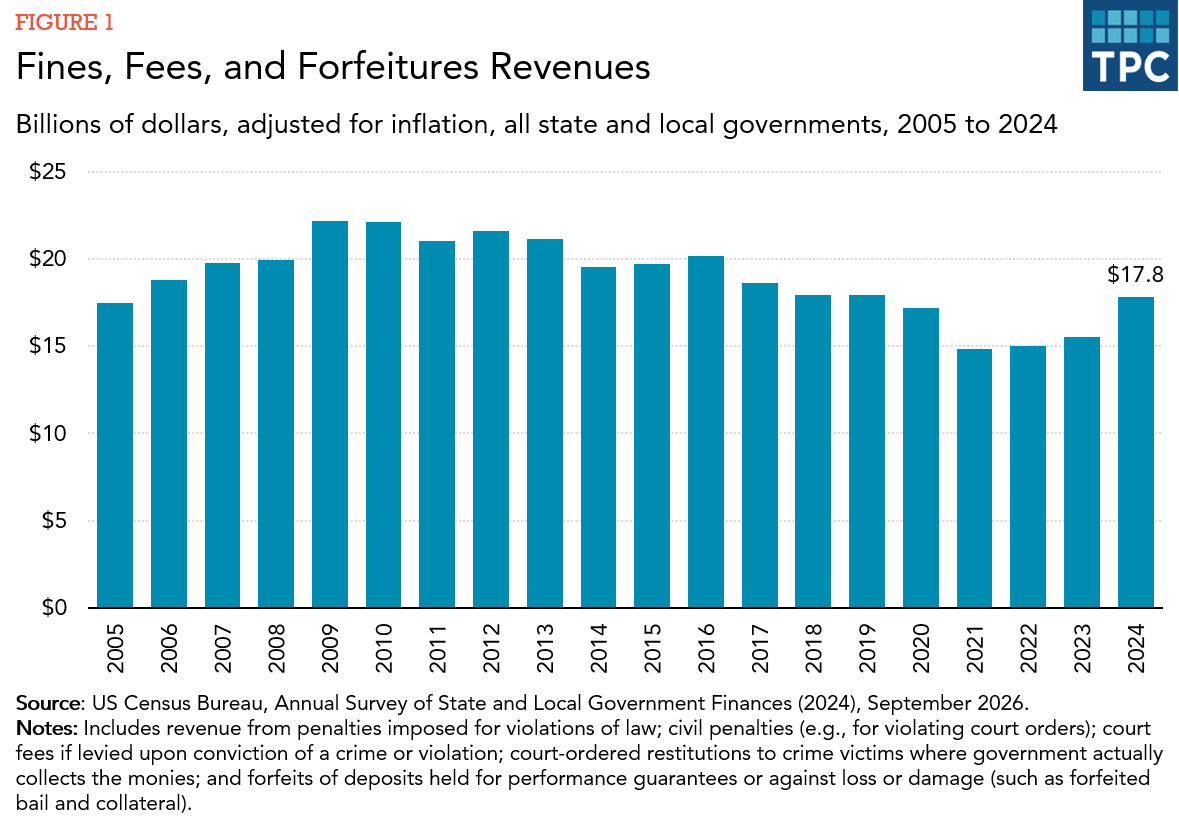
Both states and localities collected more of this revenue. State governments saw fines and fees revenue increase from around $6 billion in recent years to $7.5 billion. And for local governments, revenues increased from around $9 billion to $10.3 billion.
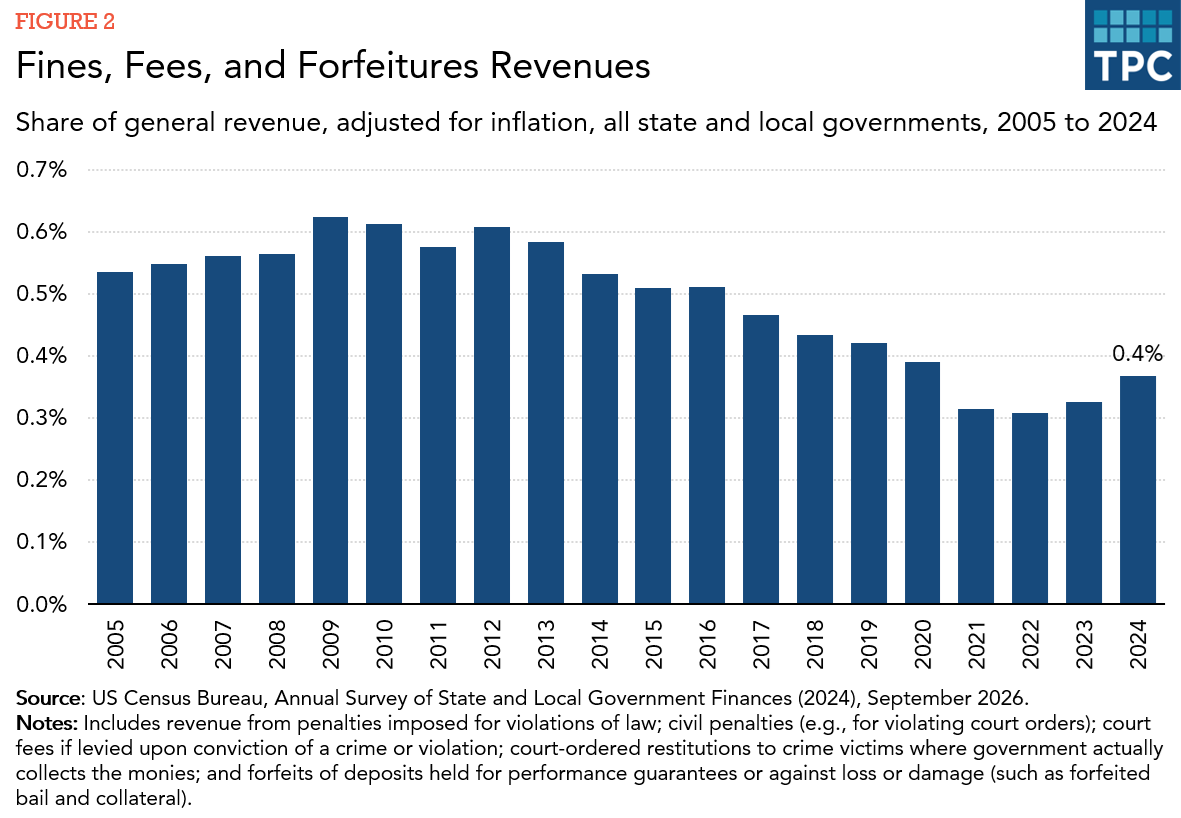
State and local revenues, overall, have grown considerably in recent decades. Fines and fees revenues, as a share of total state and local general revenues, had been falling from 0.6 percent in 2012 to a low of about 0.3 percent in 2021. That share climbed to 0.4 percent in 2024 (Figure 2).
Zooming in on specific states and localities
Fines and fees revenues were a far smaller source of revenues than income, sales, or property taxes. Combining state and local revenues, fines and fees did not exceed one percent of revenue in any state: Louisiana (0.8 percent), Maryland (0.7 percent), Colorado and North Carolina (both 0.6 percent) relied the most on fines and fees revenues.
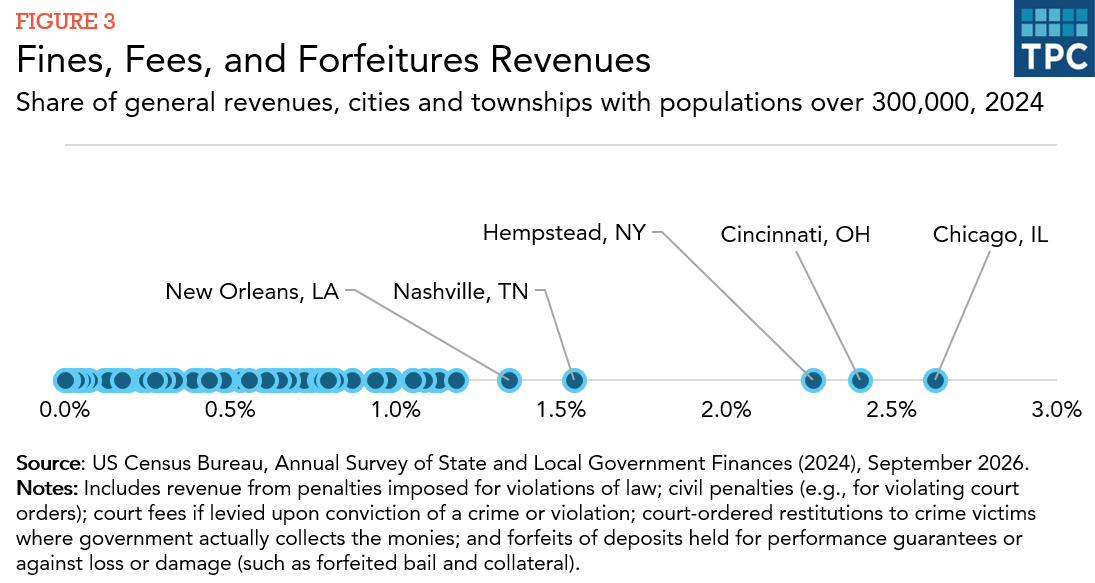
Among cities or towns with populations exceeding 300,000, New York City, NY ($1.4 billion), Chicago, IL ($358 million), and the District of Columbia ($239 million) raised the most fines and fees revenues in 2024. As a share of general revenues, Chicago, IL (2.6 percent), Cincinnati, OH (2.4 percent), and Hempstead, NY (2.3 percent) were on top (Figure 3).
According to the Census data, certain school districts, special districts, and localities relied on fines and fees for over a third of their local general revenues in 2024. These include: *
- Allendale County School District 1, SC
- Central Louisiana Juvenile Detention Center Authority, LA
- Georgetown Village, LA
- Krebs City, OK
- La Paz County, AZ
- Lone Wolf School District 2, OK
- Lugoff-Elgin Water District/Authority, SC
- Poulan City, GA
- Reading Parking Authority, PA
- Savanna Town, OK
The Census data do not distinguish between fines, fees, and forfeitures, and 2024 was an unusual year for a few of these communities. Still, heavy reliance on fines and fees revenues may not be sustainable over time.
Fines and fees can be unaffordable and have unfair impacts
Unlike income or property taxes, fines and fees are rarely scaled to people’s ability to pay them. This leads to many who are charged fines and fees to incur outstanding criminal legal debts, especially among those facing court- or incarceration-related costs. These debts come with consequences like additional penalties, driver’s license suspensions, and jail, all of which are counterproductive to people being able to get to work or make payments.
Criminal legal debts can also disproportionately strain the well-being of Black households, jeopardizing their access to basic needs like groceries, housing, and health care, disrupting their paths to financial stability and wealth-building.
State and local governments can reduce their reliance on fines and fees
In the past decade, many states and localities have been eliminating certain fees, especially those that were designed to raise revenues rather than to improve public safety and accountability.
However, the new state and local finance data suggest there may be room for further reforms.
A commonsense starting point may be for state and local officials to conduct cost-benefit analyses like those undertaken in states including Michigan, New Mexico, Oklahoma, Washington state, which contributed to subsequent reforms.
They can also strengthen other stable tax revenue sources and state-local fiscal partnerships to reduce revenue pressures on police or courts. And, lastly, they can expand ability-to-pay assessments, offer community service, and roll back nonpayment penalties to reduce financial strains on families.
Fines and fees revenues are rising. The latest Census data help changemakers see which state and local governments rely on them and consider reforms that could ease residents' financial burdens.
* The US Census Bureau releases revenue and spending information for each county, city, town, special district, and school district in the US every five years. The latest comprehensive update was in 2024, for fiscal year 2022. In the interim years, Census does not include every locality in its data, so the above shortlist may be incomplete.