

The federal earned income tax credit (EITC) and the refundable portion of the child tax credit (CTC) are the largest source of cash assistance for low-income families with children, lifting 6.1 million people (including 3.3 million children) out of poverty in 2025. Together, these credits reduce poverty more than any other government program except Social Security.
But not all families raising children in the US benefit equally from these tax policies, often because of rules that limit tax benefits or exclude families entirely.
In our new research report and brief, we examine how eligibility rules for these tax credits have evolved over time. Our historical guide can help members of the 120th Congress not only understand who benefits from important tax credits and who does not, but why. It also serves as a foundation for policymakers looking to create a more inclusive and effective tax system.
How earnings and SSN requirements shape access to child tax benefits
Only people with earnings can receive the EITC, a refundable tax credit designed to encourage work, particularly among families with children. Similarly, the refundable portion of the CTC is tied to earnings. A robust body of research suggests that the EITC, in particular, has encouraged single mothers to enter the workforce.
At times, debates over earnings or work requirements in tax and nontax programs have reflected and reinforced stereotypes portraying Black families as unwilling to work and reliant on government assistance. These racially charged narratives have remained influential, despite substantial evidence disproving them.
The earnings requirement contributes to disproportionately large shares of Black and Hispanic children missing out on fully benefitting from the CTC, for example. In 2021, when the CTC’s earnings requirement was temporarily removed, racial disparities in access to the full credit amount narrowed, but the reform was not made permanent.
To claim the EITC, taxpayers and qualifying children must have Social Security numbers (SSNs) valid for employment. For the CTC, qualifying children and taxpayers must also have valid SSNs, and among married couples filing a joint return, only one spouse needs a valid SSN.
These SSN requirements parallel earlier restrictions in nontax government programs denying eligibility to immigrants, especially those who are undocumented. The political discourse around these rules has often invoked anti-immigrant rhetoric against Hispanic immigrants, in particular. Most research, however, has found that immigration has positive effects on federal finances, and that government benefits are not a major reason people migrate to the US.
Compliance concerns have shaped child-claiming connection tests
Eligibility rules that determine which taxpayer can claim a child, often called connection tests, have largely been shaped by compliance concerns, namely that people can understand and follow the rules and are able to document their eligibility. Today’s connection tests center on whether a taxpayer lives with a child more than half the year and has a close family relationship with the child. In cases where two taxpayers can claim the same child, tie-breaker rules determine the proper claiming, prioritizing parental claims over claims by other relatives.
Connection tests aim to identify the person primarily responsible for raising a child and presumed most likely to use the tax credit for the child’s well-being. In many cases, these tests accurately identify a child’s primary caregiver. If a child lives with just their married parents all year, those parents are likely to be the people caring for the child. But if a child lives in a more complex living situation, such as one that includes both parents and grandparents, the tests may deliver benefits to someone who is not the child’s primary caregiver.
In the early 1990s, Congress revised the EITC’s eligibility rules and addressed the high level of EITC noncompliance—almost 40 percent of credit claims were in error. Credit claimants no longer had to provide most of the financial support for a child, as financial support was difficult for claimants to verify. Instead, claimants had to live with and be related to a child. These connection tests were largely adopted for most child tax benefits in 2004.
But these connection tests can sometimes miss the person caring for a child. This was the case with Smyth v. Commissioner—a case in which a grandmother who lived with and was raising her two grandchildren under the same roof as one of their parents could not claim them for tax benefits due to tie-breaker rules that prioritized the claim of parents.
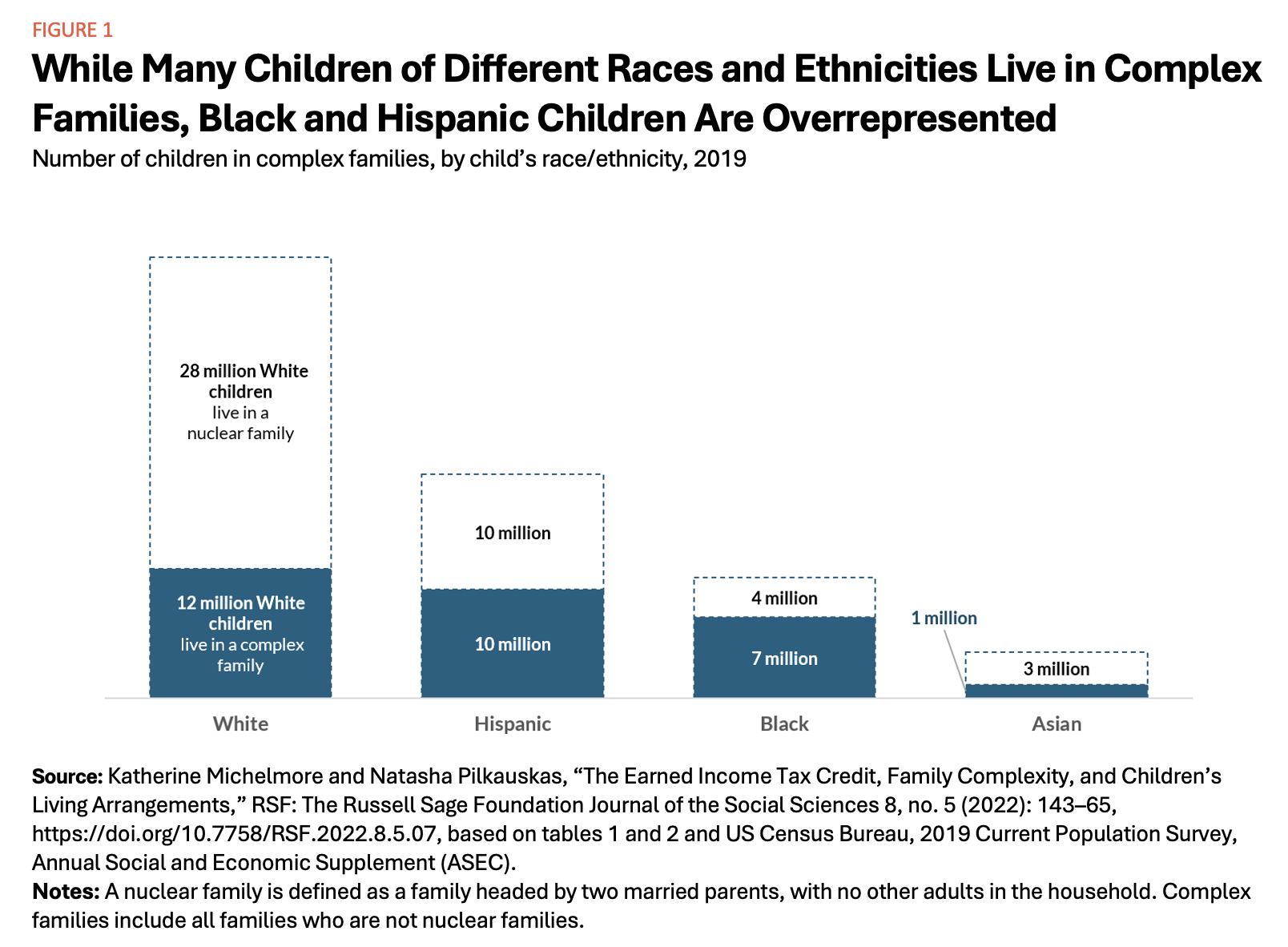
Prior research suggests that multigenerational families, kinship caregivers, and cohabitating couples may struggle to navigate and meet the requirements of connection tests. This may disproportionately affect children of color, who are more likely to live in these types of complex families (Figure 1). But a large number of White children also live in complex families. Reforms to make connection tests more inclusive and flexible would help a wide range of children in the US.
History points to potential reforms
Comparing the legislative histories of these rules suggests many opportunities exist to reform connection tests to better reflect US families’ diverse caregiving arrangements.
Making connection tests more inclusive and flexible, such as by modifying the tie-breaker rules to allow relatives who are the primary caregiver to claim tax benefits or modifying the relationship tests to allow nonrelatives caregivers to be eligible, could help reduce racial disparities in access to tax benefits, since Black and Hispanic children are more likely to live in complex families. These changes would benefit children broadly across racial and ethnic groups, but they may not address disparities associated with earnings and SSN requirements.
History also shows us that to be effective and workable, reforms will need to address compliance. Policymakers need to ensure that taxpayers can understand and document their eligibility, and that the IRS has the capacity to administer these rules effectively.